
Lagoon Odor Control Without Chemicals or Masking Agents
If your lagoon smells like rotten eggs and chemicals only buy time, the problem is below the surface. Full-depth mixing returns oxygen to the bottom so hydrogen sulfide stops forming. In La Grande, Oregon, dissolved oxygen rose from about 0.2 to an average of 1.9 mg/L, and odor stopped. Titus Wastewater Solutions designs each layout around your lagoon’s dead zones.
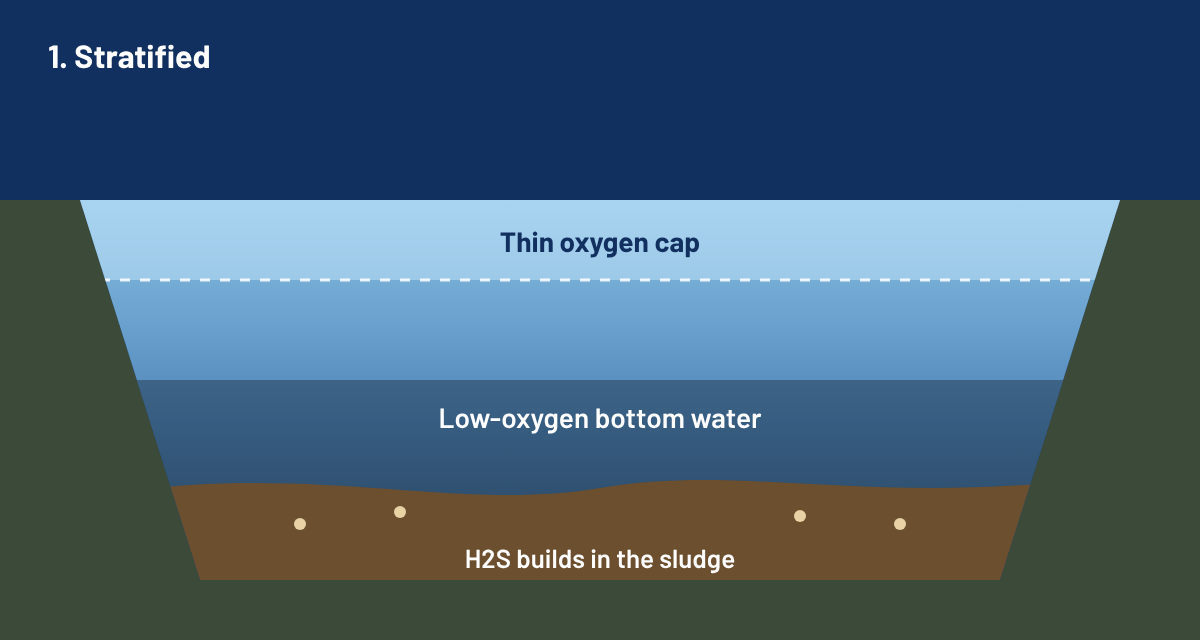
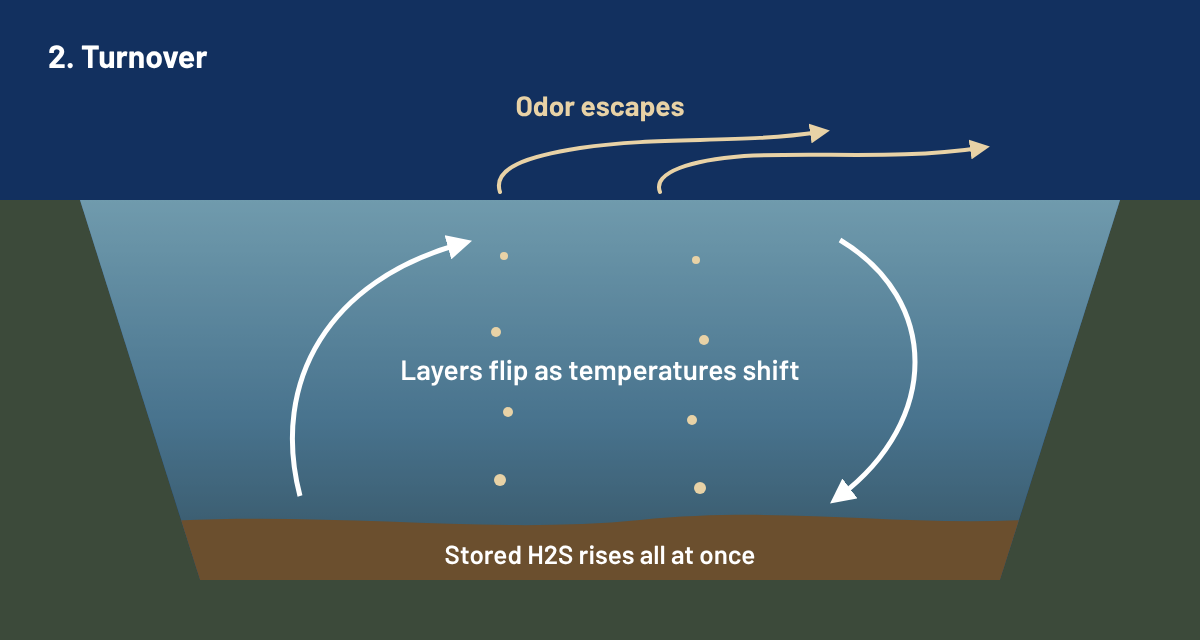
When temperatures shift in spring and fall, the layers flip. Low-oxygen bottom water and stored hydrogen sulfide rise together, the oxygen cap can’t keep up, and the odor drifts off site.
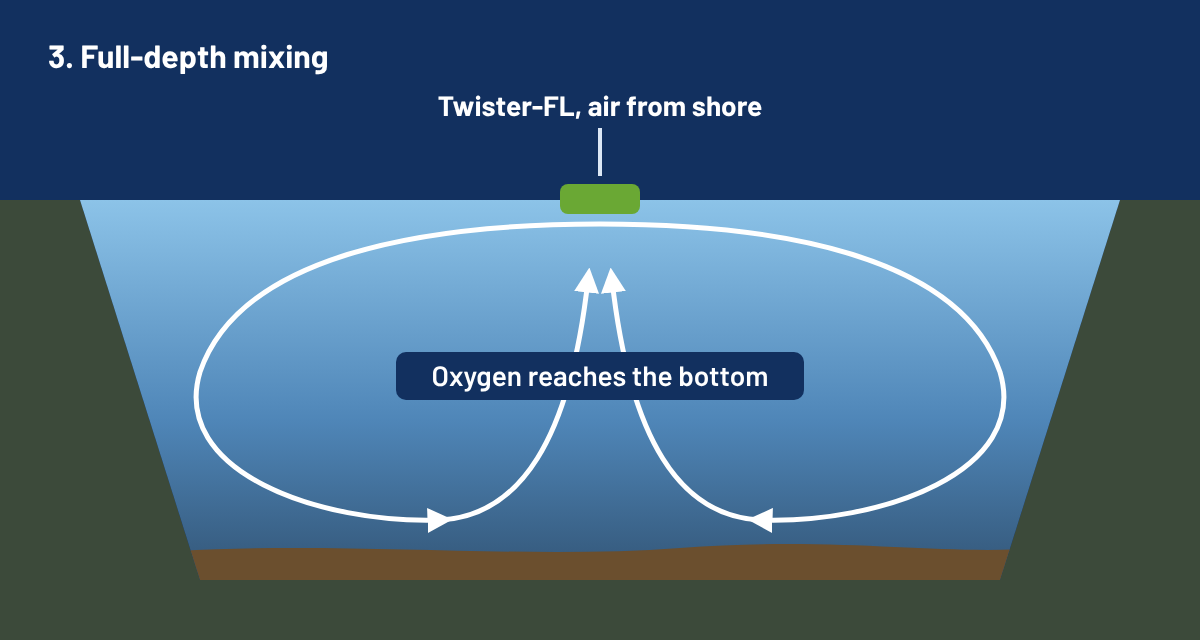
Floating AirLift units circulate the full water column, so oxygen reaches the sludge layer and there’s no stagnant bottom layer storing gas for turnover. In La Grande, Oregon, dissolved oxygen rose from about 0.2 to an average of 1.9 mg/L.
Signs Your Lagoon Odor Won’t Fix Itself
Lagoon odor won’t fix itself when it outlasts a normal turnover, returns every season, or comes back after every treatment. Those patterns point to a lagoon bottom that never gets enough oxygen, not a one-time event. If you’re still working out where the smell is coming from, start with what your lagoon odor is trying to tell you.
Odor lasts more than two weeks
A normal turnover passes quickly. Odor that hangs on means something underneath is wrong.
It comes back every spring and fall
A lagoon that smells at every turnover is storing gas the rest of the year.
Chemicals only buy time
If the smell returns when dosing stops, the source hasn’t changed.
Odor returned after dredging
Removing sludge doesn’t fix the mixing that let the bottom go anaerobic.
Bottom DO reads near zero
Surface readings can look fine while the sludge layer has no oxygen at all.
Adding aerators didn’t help
Extra units of the same type still leave the dead zones between them untouched.
A short turnover smell can pass on its own. A pattern like this won’t, but it can be stopped at the source once oxygen reaches the bottom.
What Causes Lagoon Odor
Lagoon odor is caused by hydrogen sulfide that forms when the bottom of a lagoon runs out of oxygen, usually because poor mixing keeps oxygen from reaching it. Turnover is when you notice it. These three conditions are why it happens.
An Anaerobic Bottom Layer
When dissolved oxygen runs out near the sludge layer, sulfate-reducing bacteria take over and produce hydrogen sulfide. A thin oxygenated layer near the surface can hold that gas in for a while, but it can’t stop it from forming.
Dead Zones Between Aerators
Fixed aerators move the water closest to each unit. The quiet areas between them see little circulation, so oxygen never reaches the bottom there, and those are the spots where odor starts.
Sludge That Keeps Building
Every inch of sludge is more material for bacteria to turn into gas. As lagoon sludge buildup gets deeper, odor tends to get worse each season.
Fix the oxygen and mixing problem at the bottom, and turnover has nothing stored up to release.
Lagoon Odor Control Options: Treating the Smell vs. Fixing the Cause
Lagoon odor control options fall into two groups: treatments that deal with hydrogen sulfide after it forms, and fixes that change whether it forms at all. The test that separates them is whether the odor is still gone after the next turnover.
| Approach | What It Does to H2S | When It Stops Working | What You Keep Paying For | Holds Up Through Turnover? |
|---|---|---|---|---|
| Treat the Smell | ||||
| Chemical dosing | Oxidizes or binds it after it forms | When dosing stops | Chemical purchases and handling | Only with heavier dosing |
| Masking and neutralizing sprays | Covers the smell in the air | When spraying stops | Product and labor | No |
| Bacterial and enzyme additives | Adds bacteria that still need oxygen to work | When the bottom stays anaerobic | Repeat doses | Rarely |
| Covers | Traps it under the cover | Gas keeps forming underneath | Installation and upkeep | Contains it, doesn’t prevent it |
| Fix the Cause | ||||
| Dredging | Removes sludge that feeds it, but doesn’t change mixing | As sludge rebuilds | A major project every time | Until the sludge returns |
| Fixed aerators (bottom diffusers, tube, surface, and aspirating units) | Adds oxygen near each unit | In the dead zones between units | Power, cleaning, and often boat work | Dead zones still store gas |
| Twister-FL Floating Aerator | Keeps oxygen at the bottom so it stops forming | Keeps working as long as the blower runs | A blower on shore; no moving parts in the water, no boat work | Yes, with no stored gas to release |
La Grande, Oregon, worked through this table before finding the fix:
2018
Odor starts coming off the pre-air cell.
2020
The city dredges the cell. The odor comes back.
2026
All 72 tube aerators are replaced with four Twister-FL units and two Twister SDF units.
How to Stop Lagoon Odor at the Source
To stop lagoon odor at the source, keep oxygen moving through the full depth of the lagoon so the bottom never goes anaerobic. Lewis Titus describes the chain in three links: anaerobic basin, low DO, odor. Break the first link, and the other two go with it.
Titus WWS breaks that link with AirLift technology:
- Air comes from shore. A blower on the bank feeds each floating unit, so there’s nothing electrical and no moving parts in the water.
- Low-oxygen water is pulled up from the bottom. Air released inside the unit lifts water from the bottom, the layer where hydrogen sulfide forms, and brings it into contact with oxygen.
- Oxygenated water spreads in every direction. It discharges 360 degrees just below the surface and circulates back down, so oxygen reaches the bottom across the lagoon. Each Twister-FL moves about 1.7 million gallons per hour.
Getting Ahead of Spring and Fall Turnover
Turnover releases a season’s worth of gas when a lagoon has stratified. Full-depth circulation keeps the water column from separating into those layers, so there’s far less stored gas to come up when temperatures shift. Because the units float and are loosely tethered, they can be moved toward problem areas from shore before the season changes, with no boat work.
Twister-FL Floating Aerator
- Runs on air alone, with nothing electrical or moving in the water
- Floats above the sludge, so it can’t get buried in the layer that makes the odor
- Loosely tethered, so it can be moved toward dead zones
- Maintained from the bank, with no boat work
Lagoon Odor Control Results
Full-depth mixing has stopped odor in working lagoons by getting oxygen to the bottom and keeping it there. Here’s what that looked like in two of them.
City of La Grande, Oregon
“At this time we have no odor coming off of our pre air cell.”
The numbers behind that quote are about oxygen, because oxygen is what stopped the odor.
About 0.2 mg/L
Dissolved oxygen before the switch
1.9 mg/L
Average dissolved oxygen, September and October 2026
1.5 mg/L
Lowest reading in those two months
No odor
Coming off the pre-air cell
The low reading matters as much as the average. Odor comes back when oxygen dips, and through September and October, La Grande’s pre-air cell never dropped below 1.5 mg/L. The city is tracking the cell every three months for the next year, so these numbers will keep updating.
Village of Lakeview, Michigan
Lakeview’s old system pushed air through weighted, perforated hoses on the lagoon bottom. The hoses clogged, algae mats built up on the surface, and neighbors complained about the smell. After the village switched to Twister-FL floating aerators, the odor, the mats, and the clogging were resolved.
What to Expect After the Switch
In both lagoons, results came in the same order:
- Dissolved oxygen stabilizes. Readings climb and stop crashing.
- Odor drops. With oxygen at the bottom, hydrogen sulfide stops forming.
- The sludge layer starts shrinking. Over the following months, bacteria break down the material that was feeding the odor.
Every lagoon moves at its own pace, depending on size, loading, and water temperature.
Get a Lagoon Odor Assessment
A lagoon odor assessment shows where oxygen is falling short in your lagoon and what it takes to fix it. Send us your lagoon’s size and depth, plus any dissolved oxygen readings you have. We’ll map out the layout your lagoon needs and what to expect through the next turnover.
Fielding complaints right now? Call (877) 582-9899 to talk with the team directly.
Lagoon Odor Control FAQs
Why does my lagoon smell worse in spring?
Spring odor usually comes from turnover. Over the winter, the lagoon stratifies, and the bottom layer runs low on oxygen while the sludge keeps producing hydrogen sulfide. When the ice comes off and the water warms, the layers mix and that stored gas reaches the surface over a few days. A lagoon kept in full-depth circulation doesn’t build up those layers, so there’s far less gas waiting to come up.
What causes a rotten egg smell from a lagoon?
A rotten egg smell is hydrogen sulfide. When the sludge layer runs out of oxygen, sulfate-reducing bacteria use the sulfate in wastewater instead and give off H2S, which people can smell at very low concentrations. The smell means part of the lagoon has gone anaerobic, usually because mixing isn’t carrying oxygen all the way to the bottom.
What happens when a lagoon goes anaerobic?
When a lagoon goes anaerobic, dissolved oxygen near the bottom falls close to zero and the bacteria that need oxygen give way to bacteria that don’t. Treatment slows, sludge builds faster, and the lagoon starts producing hydrogen sulfide. The smell is usually the first thing anyone notices, but the oxygen problem started before it.
Can aeration eliminate lagoon odor?
Aeration can eliminate lagoon odor when it reaches the bottom. Aerators that only work the surface, or a small area around each unit, leave dead zones where the sludge stays anaerobic and keeps making hydrogen sulfide. Full-depth mixing keeps oxygen moving through the whole water column, so the odor stops forming instead of being chased after it appears.
How fast does lagoon odor go away after adding mixing?
Odor drops as dissolved oxygen recovers, so the timeline follows the oxygen. La Grande, Oregon, completed its Titus layout in July 2026, and by September and October its pre-air cell averaged 1.9 mg/L of dissolved oxygen with no odor coming off it. Lagoon size, sludge depth, temperature, and loading all affect how quickly a lagoon gets there.
Is chemical odor control a long-term fix?
No. Chemical dosing and masking agents act on hydrogen sulfide after it forms, so the odor returns when treatment stops, and the cost repeats every season. They can help in an emergency, but state lagoon guidance describes products like sodium nitrate as temporary. A long-term fix changes the conditions at the bottom so the gas doesn’t form.
How many aerators does it take to control lagoon odor?
It depends on your lagoon’s acreage, depth, and where the dead zones sit, not on the number of units you have now. More aerators of the same type rarely reach the areas between them. La Grande replaced 72 tube aerators with four Twister-FL units and two Twister SDF units. Send us your lagoon’s size and depth, and we’ll show you what yours needs.
Titus Products for Lagoon Odor Control
If odor is coming from the lagoon itself
Start with the Twister-FL floating lagoon aerator. It keeps oxygen moving through the full depth of the lagoon, so the sludge layer stops producing hydrogen sulfide.
If wastewater is already septic when it arrives
Odor control can start upstream. The Twister Mixing Aerator keeps wastewater aerobic in lift stations and wet wells and breaks up grease, so less septic flow and grease reach the lagoon.
If inflow is carrying grit into the lagoon
Grit settles into the sludge layer and stays there. TwistLift Locks/EJ Access locks down and seals manholes, so less stormwater and grit get into the system on the way to the lagoon.
If liners or joints need repair
A leaking liner or failed joint shouldn’t slow down an odor fix. Titus Industrial Tapes are built for geomembrane seams, concrete joints, and buried pipe, where repairs have to hold up wet.
Related Problems
- Lift station odor: Hydrogen sulfide that forms in the collection system before flow reaches the lagoon.
- FOG and surface mats: Why surface mats get misdiagnosed, and what one plant learned after 30 years of fighting them.
- Lagoon aeration cost: How the lowest bid can turn into the highest lifetime cost.
- Lagoon aerator maintenance: Why a maintenance plan that needs a boat crew rarely gets followed.
Stop Chasing Lagoon Odor Every Season
You can stop chasing lagoon odor every season by fixing the oxygen problem underneath it. Tell the Titus WWS team your lagoon’s size, depth, and when the smell is worst, and they’ll show you where oxygen is falling short and what full-depth mixing could change before the next turnover.
Prefer a phone call? Reach the team at (877) 582-9899, or contact the Titus WWS team.