
TL;DR
Purchase price is the smallest part of lagoon aeration cost. Maintenance labor, offshore access, downtime, and dredging show up years later and almost never appear in a bid.
Equipment that rags, sits mid-lagoon, or mixes poorly drives repeat repairs, boat and crane calls, and sludge that eventually has to be hauled out.
Compare aerators across five categories before you sign: initial cost, routine operating cost, corrective maintenance, access and support, and long-term system cost.
When a utility evaluates lagoon aeration equipment, the initial purchase price is impossible to ignore. Capital budgets are limited, public agencies have to justify every expenditure, and engineers are frequently asked to compare bids on horsepower, oxygen transfer, and price. Those figures fit neatly into a spreadsheet.
The costs that follow do not. An aerator is purchased once and paid for repeatedly, through rag removal, boat trips, crane rentals, the motor that fails in year three, and the dredging project that arrives a decade later. Lagoon aeration cost is easy to underestimate because most of it does not show up until the equipment is already in the water and the utility has no practical way to change course.
Lewis Titus, founder of Titus Wastewater Solutions, spent much of his career in industrial maintenance before entering the aeration business, and that background shapes how he evaluates equipment. The question is never whether a machine performs when it is new. It is what a crew has to do to keep it running, how often, and at what risk. The sections below break down where lagoon aeration costs actually accumulate after installation, and give you a five-category framework for comparing systems on what they cost to own rather than what they cost to buy.
What Lagoon Aeration Cost Actually Includes
Equipment comparisons tend to focus on the numbers that fit cleanly onto a bid tab:
- purchase price
- installation cost
- standard aeration efficiency (SAE), or pounds of oxygen delivered per horsepower-hour
- standard oxygen transfer rate (SOTR), or total pounds of oxygen delivered per hour per unit
- mixing efficiency, or gallons moved per horsepower-hour against total gallons moved per unit per hour
Those numbers matter. The first five appear on nearly every spec sheet, which is exactly why bids get compared on them. Mixing efficiency often does not, and that gap is the first sign that the easiest numbers to compare are not the ones that determine what a system costs to own.
- Labor and parts. Routine maintenance hours, rag removal, bearing lubrication, gearbox service, electrical troubleshooting, and the eventual replacement of motors, blowers, propellers, and shafts. Every one of those hours comes out of a crew that already has lift stations, collection systems, and emergency calls to cover.
- Access. Boats, barges, cranes, rigging, and the outside contractors who show up when equipment sits too far from shore to reach any other way. Access cost scales with distance from the bank, not with the size of the repair.
- Downtime. Treatment capacity lost while a unit waits on a part, a contractor, or the weather. Depending on the season and the loading, that stops being a maintenance issue and becomes a compliance one.
- Long-term consequences. Sludge accumulation, dredging, hauling and disposal, and the liability exposure that comes with putting people on or in a lagoon to service equipment. Hazardous materials such as PFAS are pushing disposal costs higher still, which means sludge a utility could have afforded to remove ten years ago may cost considerably more to remove now.
None of these costs show up in year one, which is what makes them easy to discount during procurement. Once the equipment is in the water, they belong to the utility whether they were priced or not.
How Long Does Lagoon Aeration Equipment Actually Last?
A lower-cost component is not a bargain if it has to be replaced repeatedly. Expected service life gets treated as a minor line on a spec sheet, but it is one of the few numbers on that sheet that multiplies. Cut it in half and you have doubled what the utility spends on that component across the life of the lagoon.
Why Blowers Fail Sooner Than Expected
Blowers fail early when they are sized to run at the top of their range. Speed, pressure, and heat move together in a blower, so pushing one up drags the others with it. The additional heat works against the bearings, seals, and lubrication that keep the unit alive, and service life falls accordingly.
This is how a specification can be technically correct and still be a poor buy. A blower can satisfy the required airflow and pressure on paper while operating near its limit every hour it runs. The airflow number gets met. The replacement interval is not the one anyone budgeted for.
The useful question is not whether a machine can perform the task. It is how hard the machine has to work to perform it, how much heat that generates, and how long its major components are likely to survive under the conditions at your site rather than the conditions on the datasheet.
Replacement Frequency Belongs in Your Aeration Lifecycle Cost
Replacement frequency, not unit price, is what determines whether a component is expensive. The most costly part of an aeration system does not look costly when its price is spread across twenty years. It looks very different when it has to be replaced every year or two, and different again once each replacement drags labor, access equipment, and downtime along with it.
That pattern holds for motors, gearboxes, bearings, shafts, and propellers alike. Two systems can carry nearly identical bid prices and produce completely different twenty-year totals, entirely on the strength of how often somebody has to go out and fix them.
Rags and Lagoon Aeration Maintenance: A Cost That Compounds
Rags are the most persistent maintenance problem in municipal wastewater systems, and screening does not eliminate them. Hauled waste, pumper trucks, bypasses, and material that slips through upstream processes all deliver rags to equipment that was never designed to handle them.
When they reach a mechanical aerator, they wrap. Resistance climbs on the propeller, the motor works harder against the added load, and it eventually overloads. Breakers trip. The unit shuts down. Somebody goes out, clears the material by hand, resets it, and does it again the next time enough rags come through.
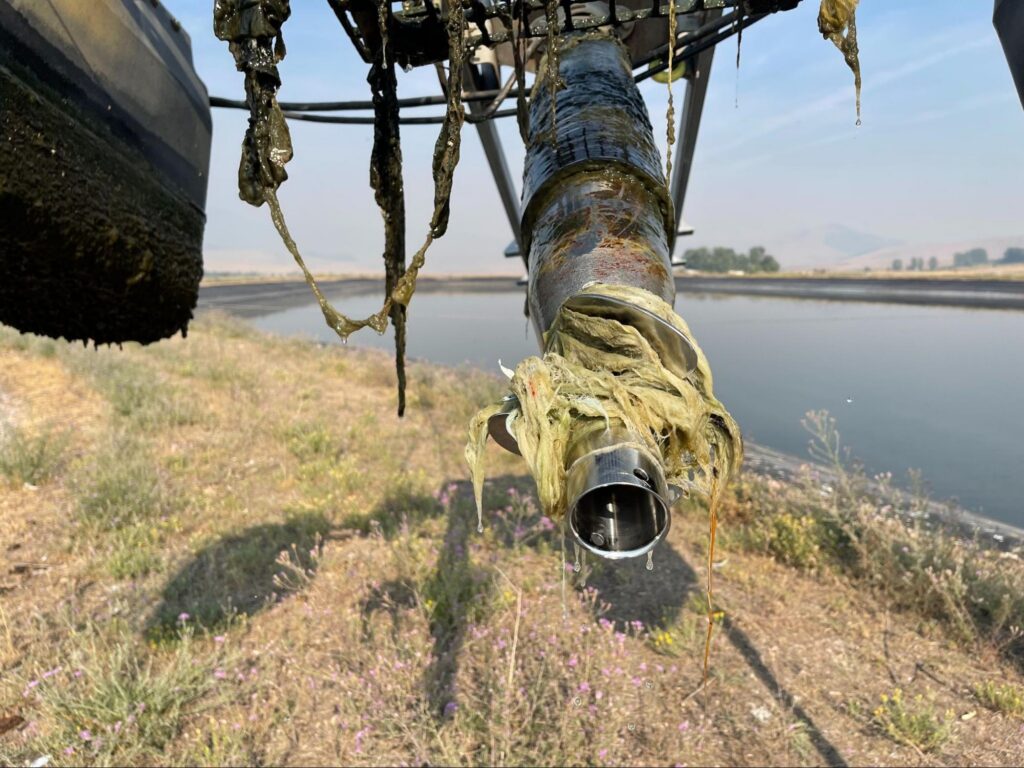
The labor to remove the material is the visible cost, and it is the smaller one. Every overload puts thermal and electrical stress on a motor you are counting on for fifteen or twenty years, which pulls that replacement forward. Every shutdown is aeration the lagoon did not get. Every emergency response takes a crew off scheduled work, which is how preventive maintenance elsewhere in the system starts slipping.
Ragging is not a cleaning problem. It is a service-life problem that presents as a cleaning problem.
There is one more cost, and it depends entirely on where the equipment sits. Clearing rags from a unit on the bank is an unpleasant hour. Clearing rags from a unit in the middle of a lagoon is not a cleaning job at all. It is an access problem, and access is where lagoon aeration cost stops being incremental.
What Does It Cost to Service an Aerator in the Middle of a Lagoon?
Servicing an aerator offshore costs several times what the same repair costs on the bank, because the work itself is the smaller half of the job. Before anyone touches the equipment, the utility has to get people, tools, and replacement parts out to it, keep them safe over open wastewater, and then get everything back. That mobilization is the expense, and it applies whether the fix takes twenty minutes or two weeks.
Towable Units Versus Fixed Offshore Platforms
How much that mobilization costs depends almost entirely on whether the equipment can come to shore or the crew has to go to the equipment.
Some floating high-speed surface aerators can be disconnected and towed toward the bank for service. That is the better position to be in, though it is not free. Someone still has to reach the unit, disconnect it, and move it safely across the water before any actual repair begins.
Large low-speed surface aerators often cannot. These systems are mounted on substantial offshore platforms and carry large motors, gearboxes, shafts, and propellers, which means surface aerator maintenance happens where the unit sits. Lewis described one lagoon running 18 large units with no practical way to reach them from shore.
When a 100-horsepower motor or a large gearbox fails in that setting, it stops being a maintenance call and becomes a project. The utility needs a boat or work barge, personnel trained and willing to work over wastewater, rigging, a crane with enough capacity and reach, the replacement components themselves, and often a specialized contractor. Crane cost climbs with both load and distance, so the farther the lift sits from the bank, the larger the crane has to be to make it. In some cases, Lewis said offshore repairs run into the hundreds of thousands of dollars and take weeks to complete.
The Same Repair, Two Very Different Bills
The clearest way to see the difference is to hold the failure constant and change only the location of the equipment.
| Same failed gearbox | Shore-accessible unit | Fixed offshore unit |
|---|---|---|
| Getting to the equipment | Walk out on the bank | Boat or work barge required |
| Who performs the work | In-house crew | Often a specialized contractor |
| Lifting equipment | Standard or none | Crane sized for load plus reach |
| Safety requirements | Routine PPE and procedures | Over-water work, rescue plan, added personnel |
| Weather and season | Minor delay | Can stop work entirely |
| Realistic timeline | Hours to days | Days to weeks |
| Cost driver | Parts and labor | Mobilization, access equipment, contractor |
The parts invoice is identical in both columns. Everything else on the list is what the utility pays for choosing where the equipment would sit, a decision made years earlier during procurement.
Downtime Is Lost Treatment Capacity, Not Just a Broken Machine
When an aerator is out of service, the utility is not down one piece of equipment. It is down a portion of its treatment capacity, and the lagoon does not pause while the repair gets scheduled.
What follows depends on the lagoon’s design, its loading, the season, and how much redundancy exists. Dissolved oxygen falls first. Circulation weakens, solids settle out of suspension, and the biology that was doing the actual treatment work slows down in the zones that lost oxygen. From there it moves outward into the things people notice: odor, uneven treatment, and discharge numbers that drift in the wrong direction at the worst possible time. The EPA’s lagoon troubleshooting manual covers how these conditions present in lagoon systems and what tends to drive them.
This is why the consequence of a failure matters as much as its likelihood. A system built around several smaller units absorbs a single loss differently than one built around a few large ones. Losing one of twelve units is a scheduling problem. Losing one of three, in August, with no backup aeration and a four-week lead time on the part, is a compliance problem.
A lower purchase price offers no protection in that second scenario. The bid saved money once. The reduced capacity costs the utility every day the unit sits.
Poor Mixing Is the Most Expensive Lagoon Aeration Cost of All
The largest hidden cost in a lagoon aeration system is usually not the aerator. It is the sludge the aerator failed to keep suspended, and the dredging project that eventually removes it.
Why Limited Area of Influence Turns Into Sludge
Aeration equipment has to do more than introduce oxygen. It has to move enough water to keep solids suspended and available to the biology doing the treatment work. When mixing falls short, solids settle, and settled solids stop being treated.
This is what a limited area of influence looks like over time. Equipment that stays fixed in one location keeps the water immediately around it moving, and that zone looks healthy. Beyond it, sludge builds quietly for years. Effective lagoon volume shrinks, short-circuiting develops, odors surface, treatment gets uneven, and operational flexibility narrows until dredging is the only option left. The Twister-FL Floating Aerator was built around that specific gap, moving the full water column across a far wider footprint so solids stay in play instead of accumulating past the reach of the equipment.
Lewis cited one project where a lagoon had accumulated roughly ten feet of sludge. The owner spent approximately $2 million on an 80% dredging project. In a smaller lagoon, dredging came to roughly $250,000.
Neither of those numbers appeared on an equipment bid. Both were paid for by a mixing decision made years earlier.
Wastewater Lagoon Dredging Cost Goes Well Beyond Excavation
Removing the sludge is only one line on a dredging invoice. A full project typically also requires:
- sampling and characterization
- permitting
- dewatering
- temporary storage
- hauling
- disposal or land application
- environmental controls
- contractor mobilization
- lagoon shutdown or operational adjustments
- biosolids treatment, where required
Every one of those depends on where the material can legally and practically go, and contaminants in the sludge narrow those options fast. That is what makes poor mixing such a long financial tail: the utility pays for years of reduced lagoon capacity first, then pays again to remove, handle, and dispose of what accumulated during those years.
An aerator that costs more up front and meaningfully slows sludge accumulation can outperform a cheaper unit by a wide margin, and the math is not close once a dredging project enters the picture.
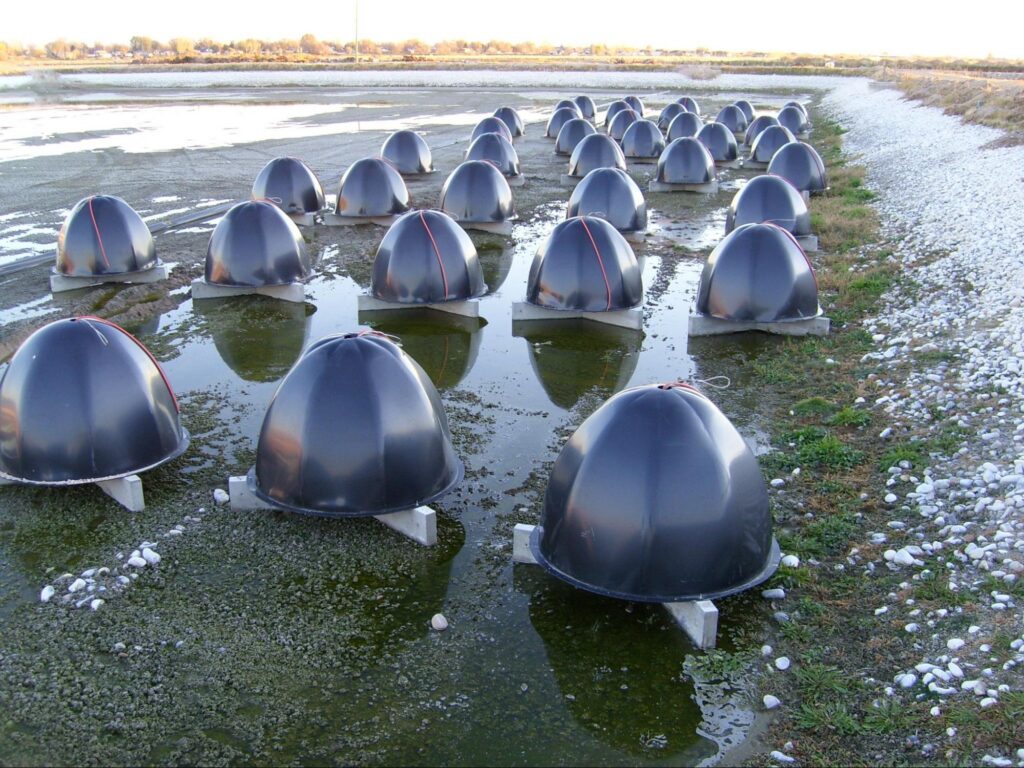
One of the worst maintenance outcomes Lewis has seen came out of a very small town that installed hundreds of dome-shaped bottom diffusers at the direction of its state regulators. Each dome was individually piped and set on a heavy concrete anchor system, with a basket of media inside to give bacteria a surface to colonize and an EPDM membrane diffuser releasing air up through it. On paper it was an efficient system, and for a while it performed like one.
Sludge accumulation blinded the diffusers within a few years. Recovering from it required a very large crane to pull every dome for cleaning and repair, plus a full dredging project to remove the sludge that had buried them. The total cost exceeded what the town had paid to install the system in the first place.
That is the pattern in its clearest form. The equipment met its specifications, satisfied the regulator, and still ended up costing more to recover than to buy.
Bottom Diffuser Maintenance: Why Fouling Costs More and Delivers Less
Maintenance conditions and energy efficiency are the same conversation. Equipment does not hold its published performance while its condition degrades, and the utility pays for that gap twice.
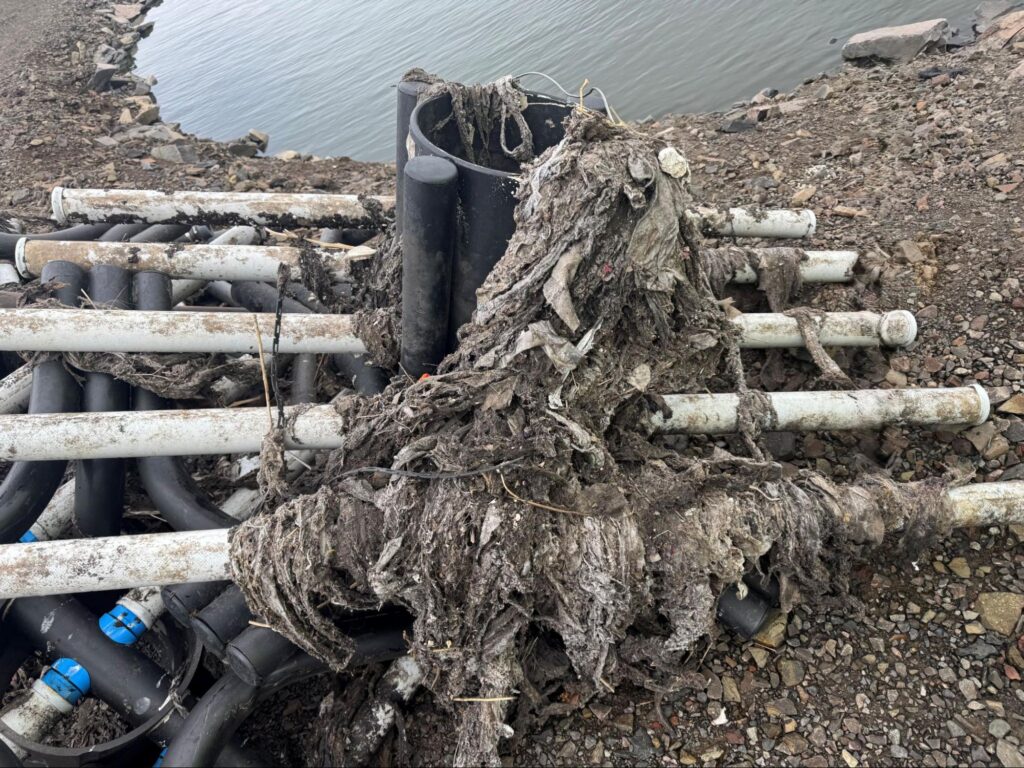
Submerged diffusers illustrate it clearly. They can be genuinely efficient, and they are also sitting in the worst possible environment for staying that way. Sludge, rags, biological growth, and membrane fouling all restrict airflow over time. As that restriction builds, system pressure rises, the blower works harder to deliver the same air, and energy consumption climbs while oxygen delivery falls. Dissolved oxygen drops, treatment performance follows, and the utility ends up paying more for less.
That penalty lands on the largest electrical load at the plant. In facilities running activated sludge, aeration accounts for roughly 50 to 60 percent of total electricity use, according to EPA figures published by the American Council for an Energy-Efficient Economy. Lagoons run a different process, but the principle carries: aeration is the dominant power draw, which means a fouling problem is not a minor efficiency issue. It is a surcharge applied to the biggest line on the power bill, and it grows quietly until someone investigates why demand keeps creeping up.
Eventually the equipment has to come out to be cleaned or replaced, and that is where bottom diffuser maintenance stops being an energy problem and becomes an access problem again. Submerged components buried in sludge require boats, barges, winches, pressure washing, and significant labor before any maintenance actually begins.
The published energy number describes how a system performs in good condition. Lifecycle cost is determined by what it takes to keep it in that condition, and how much the utility pays during the stretches when it is not.
Bottom diffused air systems are especially prone to this pattern. The decline is gradual rather than sudden, so performance slips quietly over months while readings still look acceptable, and the problem often surfaces as a compliance issue before anyone traces it back to the diffusers.
Maintenance Labor Is the Cost Nobody Budgets
Every hour a crew spends unragging an aerator, greasing an offshore motor, or pulling submerged equipment is an hour that did not go somewhere else. Maintenance staff are a fixed resource, and aeration equipment competes for them against everything else the utility owns:
- pumps
- lift stations
- collection systems
- manholes
- electrical systems
- treatment equipment
- vehicles
- buildings
- emergency response
- preventive maintenance
That list does not shrink when an aerator needs attention. It just gets deferred. Lewis has seen facilities where maintaining a large number of mechanical aerators became close to a full-time responsibility on its own, which means the aeration system stopped being one asset among many and started dictating how the department spends its week.
The budget consequences follow from there, and they show up in places that never get traced back to the aeration purchase. Utilities add staff or absorb the work through overtime. They bring in outside contractors for jobs the crew cannot get to. They pay for specialized training, rent equipment more often, and carry a deeper parts inventory because unplanned failures do not wait on a purchase order.
None of that appears in the procurement file. All of it is the direct result of buying equipment that demands constant attention, and it is why a lower purchase price can quietly become the most expensive line in an operations budget.
Safety Is a Real Cost, Even When Nobody Gets Hurt
Worker safety should never be reduced to a line item. From a procurement and risk-management standpoint, though, unsafe maintenance requirements carry financial consequences that belong in the comparison.
Lagoon aeration maintenance puts people in contact with a difficult combination of hazards: unstable floating equipment and slippery surfaces, direct wastewater contact, deep water, cold and ice in winter, heavy components and rotating machinery, electrical power near water, and crane and rigging operations.
Lewis described a high-speed surface aerator that rolled while a worker was attempting to grease it. He has also seen crews sent onto floating platforms and into boats to perform what the maintenance schedule calls routine service.
Even when nothing goes wrong, that hazard profile costs money continuously. It requires written safety procedures, PPE, rescue planning, additional personnel on site because nobody performs this work alone, training, supervision, and insurance that reflects the exposure. It slows work down and pushes jobs to outside contractors who are equipped for conditions the crew is not.
When an injury or illness does occur, the costs move into workers’ compensation claims, lost time, investigations, fines, and liability. The safer system is frequently the cheaper one to own, and it is cheaper before anyone is hurt.
There is also a question that does not appear in any cost model, which is whether the work will get done at all. A maintenance strategy only functions if trained people are willing to carry it out, and that willingness can no longer be assumed.
Lewis has heard superintendents say plainly that their workers will not go out into the lagoon to service certain equipment. That is not a generational complaint or a reluctance to do unpleasant work. Employees are increasingly unwilling to accept preventable exposure to human waste, unstable footing, electrical hazards, and fall risk, and as Lewis put it:
“They’re not going to do something that they think is going to make them sick or get them hurt. And they shouldn’t.”
When the system is failing and the crew will not perform the required maintenance, the utility is left choosing among expensive options: hire a specialty contractor, rent equipment, delay the repair, run with reduced aeration, write new safety procedures, retrofit access, or replace the equipment outright. Every one of those costs more than maintenance the crew could have performed safely in the first place.
A system the available workforce will not maintain is not a sustainable system, regardless of what it cost to buy. That makes workforce reality a procurement question, not a problem to solve after the first failure.
Maintenance Access Is a Design Decision, Not an Operations Problem
Every cost in this article traces back to a choice made before the equipment entered the water. Whether a crew can reach a unit from the bank, whether it can be pulled to shore, whether a failed motor requires a crane sized for distance, whether electrical components sit in the water, and whether anyone has to stand on something unstable to perform routine service are all determined during design and procurement. After installation, they are simply facts the utility lives with for the next twenty or thirty years.
That makes maintenance access a design requirement, not a detail to work out later. An engineer can specify a system that performs well hydraulically and biologically and still leave the utility with equipment its own crew cannot safely service in February. A design is not complete until someone has answered how the equipment gets maintained, who does it, and what happens the day a major component fails. Those answers shape staffing, safety planning, and lifecycle cost as directly as horsepower and oxygen transfer shape performance.
A Five-Category Framework for Comparing Aeration Systems
A complete aerator comparison covers five categories. Most bid evaluations cover the first one thoroughly, the second one loosely, and the remaining three not at all, which is precisely where the gap between purchase price and ownership cost opens up.
| Category | What to Include | What Usually Gets Missed |
|---|---|---|
| 1. Initial cost | Equipment, shipping, installation, electrical work, anchoring or mounting, piping and air distribution, controls, startup | Little. This is the category everyone prices carefully. |
| 2. Routine operating cost | Electricity, scheduled labor, lubrication, inspections, routine cleaning, consumable parts | How energy use climbs as components foul and wear, and how many crew hours the system actually consumes |
| 3. Corrective maintenance cost | Motors, blowers, gearboxes, bearings, shafts, propellers, diffusers, electrical components, contractor labor | Replacement frequency. A cheap part replaced every two years costs more than an expensive one replaced every fifteen. |
| 4. Access and support cost | Boats, barges, cranes, rigging, specialized work procedures, rescue resources, equipment retrieval, lagoon draining if required | Nearly all of it. Access cost scales with distance from shore and rarely appears in any bid document. |
| 5. Long-term system cost | Sludge accumulation, dredging, hauling and disposal, lost treatment volume, downtime, regulatory response, major rehabilitation, equipment replacement, safety and liability exposure | Dredging, which can exceed the original equipment purchase by an order of magnitude |
This framework does not guarantee that the most expensive system is the right one. Plenty of lower-cost equipment is durable, accessible, and well matched to the lagoon it serves. What the framework guarantees is that the utility is comparing the real financial consequences of each option rather than comparing the one number that happened to make it into the bid package.
Lagoon Aerator Selection: Questions to Ask Before You Buy
The quality of a purchasing decision depends heavily on the quality of the questions asked before the contract is signed. Lewis recommends buyers build a checklist and put these directly to the manufacturer, in writing where possible. Vague answers are themselves an answer.
Ragging. A manufacturer who has never seen their equipment rag has either not sold much of it or has not asked.
☐ Will this equipment rag?
☐ What happens when rags reach it?
☐ How are rags removed?
☐ How often does that typically happen at facilities like ours?
☐ Does performance degrade gradually from sludge and rag buildup until the system is out of compliance and major maintenance is required?
Mixing and sludge. Area of influence is the number that determines whether the rest of the lagoon gets treated.
☐ What is the area of influence?
☐ How much water does the system move?
☐ Where is sludge likely to settle in a lagoon this size and shape?
☐ How does the system limit that buildup?
☐ What dredging interval should we anticipate?
☐ Is the aerator stationary, or can it be repositioned to improve mixing and reduce sludge buildup?
Major components. Ask for the basis of these numbers, not just the numbers.
☐ What is the expected motor life?
☐ What is the expected blower life?
☐ How long should the gearbox last?
☐ How quickly do propellers and shafts wear?
☐ Is the system affected by corrosion, vibration, or moving parts that wear?
☐ Can the unit be refurbished economically, or does it get replaced?
Maintenance. The last question here tells you a great deal about whether the equipment was designed with the person servicing it in mind.
☐ What has to be serviced, and how often?
☐ How long does each service procedure take?
☐ Can the work be performed from shore?
☐ Can the equipment be cleaned and disinfected before a crew handles it?
☐ Does routine maintenance require boat access?
Safety. Ask these before the equipment is specified, not after the first service call.
☐ Is there 480V power in the water?
☐ Can the equipment be removed from the lagoon for maintenance without a boat or crane?
☐ Does the equipment produce vapors that could be a breathing hazard during service?
Weather. Cold-climate performance rarely appears in a bid document and routinely determines whether a system runs in January.
☐ Does the system have to be shut down in cold weather due to freeze-ups?
☐ How does it perform in high winds?
☐ What happens to access and maintenance when the lagoon ices over?
Failure response. Every manufacturer has a best case. Ask for the typical one.
☐ What happens when this equipment fails offshore?
☐ Can the unit be brought to shore?
☐ What size crane will we need?
☐ How long does a major repair usually take?
☐ How much treatment capacity do we lose while it happens?
Cost. If nobody at the company can produce the last figure, the utility will produce it instead, one invoice at a time.
☐ What parts get replaced most frequently, and what do they cost?
☐ What specialized labor or equipment is required?
☐ How does energy consumption change as components foul and wear?
☐ What is a realistic twenty-year ownership cost?
Take these into the next vendor conversation and the comparison changes shape. The systems that look similar on a bid tab rarely hold up equally under six categories of direct questions.
Common Questions About Lagoon Aeration Cost
How much does lagoon aeration cost?
No manufacturer can quote a meaningful number without knowing the lagoon, because equipment price is the smallest variable in the total. Surface area, depth, loading, climate, existing sludge depth, and distance from shore all change what a system costs to own. Two utilities buying identical equipment can spend very different amounts over twenty years.
Is it cheaper to dredge a lagoon or fix the aeration?
Dredging is almost always the more expensive path, and it treats a symptom rather than a cause. Removing sludge restores volume temporarily, but a lagoon that was not mixing properly before dredging will not mix properly afterward, and solids begin accumulating again. Correcting the mixing addresses why the sludge built up in the first place.
Does surface aeration or diffused aeration cost less to own?
Neither format is reliably cheaper, because ownership cost depends on maintenance access more than on aeration method. Surface units are visible and often reachable, but many sit offshore. Diffusers avoid surface hazards while placing components underwater where fouling is hard to detect and retrieval is difficult. Evaluate each specific system, not the category.
How do I compare aerator bids that look nearly identical on price?
Compare them on replacement frequency, maintenance access, and area of influence rather than on price and horsepower. Ask each manufacturer what fails first, how often, who performs the repair, and whether a crew can reach the unit from shore. Those answers separate systems that bid alike. Titus WWS works with municipal utilities evaluating exactly these tradeoffs.
How do I justify a higher-priced aerator to a council or board?
Present the comparison as a twenty-year total rather than a purchase price, and quantify the avoided costs. Boards approve higher capital spending when the alternative is documented: recurring crane and contractor calls, lost treatment capacity during outages, and a dredging project that can exceed the entire original equipment purchase.
What Will It Cost You to Own?
Utilities have a genuine responsibility to spend public money carefully, and that responsibility is not always satisfied by selecting the lowest bid. It is satisfied by selecting the option that delivers the required treatment performance at the most defensible total cost.
Sometimes that really is the less expensive system. Equipment that is durable, reachable from shore, and well matched to the lagoon can be both the cheapest to buy and the cheapest to own. But when a lower price is followed by repeat motor failures, ragging, offshore repairs, crane rentals, climbing energy demand, crews who will not go out on the water, and a dredging project two decades later, that equipment becomes the most expensive thing in the lagoon.
If you are evaluating lagoon aeration equipment now, or living with a system that is costing more than anyone projected, talk with the Titus WWS team about what your current setup is actually costing to operate. Before the next bid tab comes across your desk, ask more than what it costs to buy. Ask what it will cost you to own.