
In Part 1 of this series, we broke down why most struggling lagoons do not actually have a sludge problem. They have a mixing problem. The rising sludge levels, the odors, the falling DO readings, and the permit pressure are all symptoms of the same root cause.
This is where Part 2 picks up.
Once operators accept that mixing is the underlying issue, the next question becomes obvious. Why isn’t lagoon aeration solving it?
Aeration gets most of the credit in wastewater treatment. Operators track dissolved oxygen levels. Equipment manufacturers compete on oxygen transfer rates. Engineers design entire systems around aeration capacity.
But in lagoon treatment, oxygen alone rarely does the full job. In fact, lagoon aeration without proper mixing leaves the most damaging treatment problems untouched.
Why Lagoon Aeration Gets All the Attention (And Why That’s a Problem)
Aeration is the easiest part of wastewater treatment to measure. Operators can read DO levels off a meter, manufacturers can quote oxygen transfer efficiency from a spec sheet, and engineers can point to a number and say the system is working. That measurability is exactly why aeration dominates the conversation in lagoon treatment, and exactly why so many lagoon performance problems get misdiagnosed in the first place.
When DO readings look acceptable, the assumption is that the system is functioning. But without proper mixing, solids settle outside the area of influence of the aeration system, building up and displacing the water volume required for digestion. Over time, this reduces the solids retention time (SRT) until discharge limits cannot be met, and expensive dredging becomes the only option. DO is only a measurement of oxygen in the water column, and the sludge layer below it is typically anaerobic. A lagoon can read 4 mg/L of DO at the surface and still have a significant layer of anaerobic sludge producing hydrogen sulfide and associated odors. That gap between what lagoon aeration measures and what treatment actually requires is where lagoons quietly fall apart, often for years before anyone connects the dots.
The Mixing Gap: What Lagoon Aeration Misses
In a mechanical treatment plant, mixing is built into the design. Diffusers cover the entire basin floor, and even when each one transfers a small amount of oxygen, the sheer number of them keeps water moving and solids suspended across the basin. Aeration and mixing are essentially the same job in that environment. Even with the discs very close together they still will eventually have to be mechanically cleaned as the sludge layer will build up between the discs till it adversely affects the diffusers.
Because of the sheer size of lagoons this problem is far worse. Most traditional lagoon aeration systems are of two basic types. Mechanical surface aeration, and bottom diffused air systems. They both suffer from the same dilemma. They simply do not have enough area of influence, mostly because the aerators do not physically move, the units are spaced too far apart, they do not move enough water for total mixing, and they cannot pull solids off the bottom and suspend them in the water column with adequate dissolved oxygen. Other issues add to the problem, including ragged up propellers and diffusers buried in sludge and rags. Some types of mechanical surface aerators will not function in extreme cold conditions and have to be shut down in winter months. These designs create a structural problem that no amount of additional oxygen can solve:
- Limited area of influence. A stationary lagoon aerator typically affects only a 2 to 10 foot radius around its fixed position.
- Acres of unmixed water. A typical municipal lagoon spans several acres, leaving the majority of the volume outside any aerator’s area of influence.
- Dead zones form fast. The areas between aerators sit largely undisturbed, allowing solids to settle and accumulate eventually causing the available water volume to “short circuit” passing through the lagoon without the SRT required to digest solids.
- Anaerobic sludge accumulates. Once dead zones establish, sludge thickens and the biology shifts anaerobic, resulting in H2S and odor problems.
The result is a system where oxygen is being added but never reaching the parts of the lagoon that actually need treatment. Lagoon mixing is what closes that gap, and without it, lagoon aeration alone cannot recover a failing system.
Solving the Area of Influence Problem
Every lagoon aerator has an area of influence, the zone around the unit where water is actively moving, oxygen is transferring into the column, and solids are being kept in suspension. Outside of that zone, very little happens. Most operators have heard the term, but few actually specify around it. That gap is where lagoon performance starts breaking down long before anyone notices.
Here is how the TITUS FL series floating aerator and mixers effectively solve this issue:
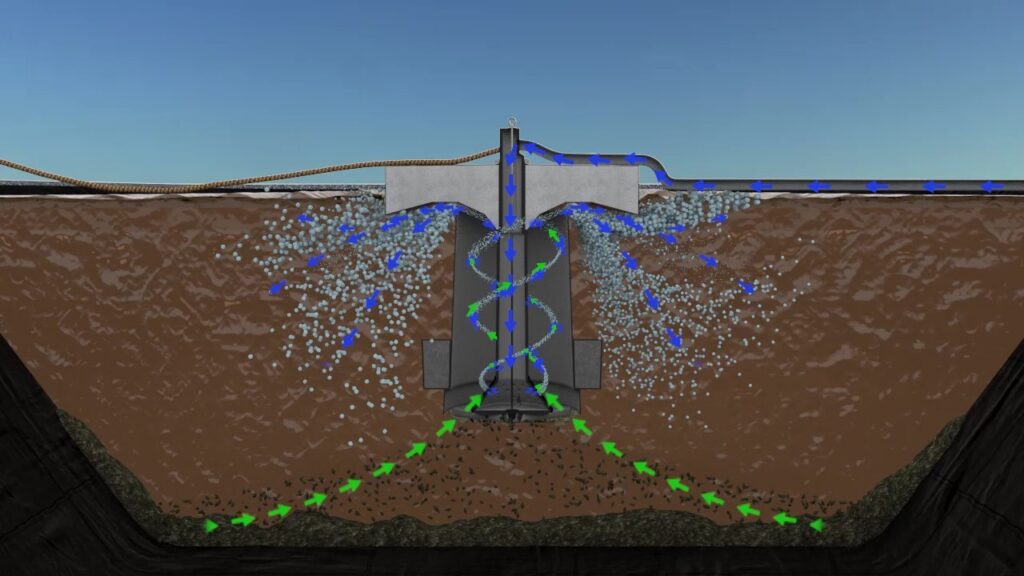
- The TITUS FL series uses “Air Lift Technology” to move massive amounts of water using very little energy.
- The TITUS FL series is a patented hybrid diffused air lift pump system. A fine bubble EPDM diffuser is mounted in a floating structure with the intake ports suspended just off the bottom of the lagoon. The diffuser uses over 40,000 tiny slits releasing fine bubbles in a confined space. As the bubbles rise, they transfer oxygen while moving large volumes of water. This system never plugs up, passing rags and solids with ease.
- The TITUS FL series has a patented 360 degree discharge float that captures the high DO water rushing upward and redirects it horizontally, then back down at 15 degrees exiting the float subsurface toward the edge of the lagoon. This creates a scouring action in the bottom of the lagoon that will not freeze in winter, even in extreme cold temps.
- The TITUS FL series has no rotational torque or thrust like mechanical aerators. This means with a loose tether it can easily be moved around the basin using the wind, or by simply changing tie off positions, limited only by the length of hose. It can be tethered with a simple rope tied to “T” posts, concrete weights, or an integrated slide system. Frequent moves eliminate sludge pockets, working as a vacuum cleaner to scour your lagoon and suspend solids, exposing volatile solids to aerobic conditions that quickly facilitate digestion. This dramatically increases your “Area of Influence” and decreases your sludge load. Non-volatile solids will eventually need to be removed, but the goal is dramatic reductions in dredging frequency and tremendous cost savings.
- TITUS Wastewater Solutions now offers another tool to improve mixing efficiency in lagoons, the Floating Directional Flow aerator (FDF). It works on the same principle as the FL series but flows directionally. Ideally, the standard FL series is placed in the center of the lagoon, with the new FDF units around the perimeter to provide O2 and a spinning effect that improves mixing even more.
You can see the full specifications of the TITUS FL Floating Aerator product line for sizing and application guidance.
To understand why a system like the FL series matters, consider the math behind traditional lagoon aeration. A 5 acre municipal lagoon covers roughly 217,800 square feet. A single aerator with a 12 foot diameter influence zone reaches about 113 square feet of that, or 0.05 percent of the lagoon. Even with eight aerators distributed across the surface, less than half a percent of the lagoon is being directly worked by the equipment. The other 99 plus percent is where solids settle, where oxygen disappears, and where anaerobic conditions take hold long before any of it shows up on a DO meter. Specifying lagoon aeration without accounting for area of influence is how facilities end up with systems that look right on paper and fail in the lagoon.
What Happens in the Untouched Zones
Once a lagoon aerator’s area of influence ends, the rest of the lagoon is operating without active treatment. That isn’t a slow decline. It’s a chain reaction that compounds quickly, and every stage feeds the next.
Here is the sequence operators see in nearly every struggling lagoon system:
- Solids settle in low-flow zones. Without mixing energy reaching them, suspended solids drop out of the water column and accumulate on the lagoon floor. The longer this continues, the thicker the lagoon sludge layer grows.
- Oxygen stops penetrating the sludge layer. Even with surface aerators running and DO meters reading fine, the oxygen never reaches the bottom. The sludge layer becomes a barrier that lagoon aeration alone cannot push through.
- Aerobic biology shuts down. Aerobic bacteria, the ones responsible for breaking down volatile solids, cannot survive without oxygen. The microbial process that should be reducing the sludge layer biologically goes dormant.
- Anaerobic conditions take over. With the aerobic process offline, anaerobic bacteria move in. This is the moment the lagoon shifts from a treatment system into a sludge accumulation system, and most operators do not catch it until the symptoms surface.
- Hydrogen sulfide and odor compounds are produced. Anaerobic bacteria release hydrogen sulfide, the rotten-egg gas behind most wastewater odor complaints. Other odor-causing compounds follow. By the time neighbors are calling, the anaerobic lagoon conditions have usually been building for months.
- Treatment capacity collapses. As the sludge layer thickens, usable lagoon volume shrinks. Solids retention time drops. The system loses its ability to process incoming load, BOD climbs, and effluent quality starts failing permit thresholds.
Every one of these stages is preventable, but only if the conditions that created them are addressed at the source. Lagoon aeration adds oxygen to the water. Lagoon mixing makes sure that oxygen, and the bacteria that depend on it, actually reach the material that needs to be treated. Without both working together, the chain reaction continues, and no amount of additional aeration can break it.
Lagoon Aeration vs. Lagoon Mixing: What Each One Actually Does
Operators often use the terms aeration and mixing interchangeably, and equipment manufacturers do not always help clarify the difference. But in lagoon treatment, they are two distinct functions, and a system that handles only one of them will eventually fail.
Here is how the two compare on the work that actually drives lagoon performance:
| Function | Lagoon Aeration Alone | Aeration With Proper Mixing |
|---|---|---|
| Adds oxygen to the water column | Yes | Yes |
| Reaches the sludge layer at the lagoon floor | No | Yes |
| Keeps solids suspended for biological treatment | No | Yes |
| Eliminates dead zones across the lagoon | No | Yes |
| Maintains aerobic conditions throughout the system | Partial, only inside the area of influence | Yes |
| Supports biological sludge reduction over time | No | Yes |
| Prevents anaerobic conditions from forming | No | Yes |
| Reduces hydrogen sulfide and odor generation | Limited | Yes |
| Protects solids retention time as load increases | No | Yes |
| Long-term outcome | Sludge accumulates, performance declines | Lagoon recovers and stabilizes |
The pattern is hard to miss. Lagoon aeration handles one job. Lagoon mixing handles the rest. A system designed around aeration alone leaves most of the lagoon’s actual treatment work undone, which is why so many facilities end up cycling through aeration upgrades without ever solving the underlying problem.
Why Mixing Drives Treatment
The reason mixing matters more than most operators realize comes down to one principle of biological treatment.
Effective wastewater treatment requires three things to be in contact with each other at the same time:
- Bacteria that digest organic material
- Oxygen that keeps those bacteria alive and active
- Organic material in the form of suspended solids that need to be broken down
Aeration handles one of those three. Lagoon mixing handles whether the other two ever meet.
When solids are kept suspended, bacteria and oxygen have constant access to the material that needs treatment. The biological process runs the way it is supposed to. When solids settle out into a sludge layer, that contact breaks. The bacteria cannot reach the material, the oxygen cannot reach the bacteria, and the lagoon stops treating waste even though it looks like it is.
Aeration adds oxygen to the lagoon. Lagoon mixing makes sure that oxygen, and the bacteria using it, actually reach the material that needs to be treated.
Without both, treatment becomes uneven and inefficient. With both working together, the lagoon’s biology can do the work it was designed to do, and the system starts performing the way operators expect.
What Effective Lagoon Treatment Looks Like
The goal of fixing a struggling lagoon is not to add more aeration. It is to restore the conditions that let the lagoon’s own biology do the work. When lagoon mixing is properly addressed alongside aeration, the system can recover on its own, often faster than operators expect.
That recovery follows a predictable pattern:
- Oxygen reaches every part of the lagoon. Aerobic bacteria reactivate in zones that had gone anaerobic, and the biological process restarts.
- The sludge layer reduces biologically. Volatile solids get digested instead of accumulating, leaving stable inert material behind.
- Odors drop off. With anaerobic conditions reversed, hydrogen sulfide production slows.
- Treatment capacity returns. Solids retention time recovers as usable lagoon volume comes back.
- Dredging gets pushed out or avoided. When biology is doing its job, major dredging projects become far less urgent.
A traditional aerator with a fixed area of influence cannot deliver the mixing energy a full lagoon needs. The TITUS Twister FL Floating Aerator was built to close that gap.
Aeration alone cannot fix a struggling lagoon. Aeration combined with proper lagoon mixing can.
FAQs About Lagoon Aeration
What is the difference between lagoon aeration and lagoon mixing?
Lagoon aeration adds oxygen to the water. Lagoon mixing keeps oxygen, bacteria, and suspended solids in contact so biological treatment can happen throughout the lagoon. Aeration alone delivers oxygen but cannot reach the sludge layer or the dead zones where most treatment problems develop.
Why does my lagoon smell when my DO readings are fine?
A lagoon smells with normal DO readings because anaerobic sludge at the bottom of the lagoon produces hydrogen sulfide, even when the upper water column has acceptable oxygen levels. DO readings only measure oxygen at the testing point, not throughout the full water body. Persistent odor is a sign of failed lagoon mixing, not insufficient aeration.
What is area of influence in a lagoon aerator?
Area of influence is the zone around a lagoon aerator where water moves, oxygen transfers, and solids stay suspended. Most stationary lagoon aerators have an area of influence of 8 to 12 feet in diameter, which leaves the majority of a multi-acre lagoon untreated.
Can adding more aerators fix a failing lagoon?
Adding more aerators usually cannot fix a failing lagoon if the underlying problem is poor mixing rather than insufficient oxygen. More aerators of the same type expand treated zones slightly but leave dead zones in between, where sludge continues to accumulate. The reliable fix is equipment that delivers both aeration and full lagoon mixing.
How do you reduce lagoon sludge without dredging?
You reduce lagoon sludge without dredging by restoring aerobic conditions so bacteria can digest volatile solids biologically. This requires lagoon mixing that reaches the sludge layer, oxygen distributed throughout the full water body, and time for aerobic bacteria to break down accumulated solids. The sludge layer shrinks over months as biology does the work dredging would have done physically.
What is the difference between lagoon aeration and lagoon mixing?
Lagoon aeration adds oxygen to the water. Lagoon mixing keeps oxygen, bacteria, and suspended solids in contact so biological treatment can happen throughout the lagoon. Aeration alone delivers oxygen but cannot reach the sludge layer or the dead zones where most treatment problems develop.
Why does my lagoon smell when my DO readings are fine?
A lagoon smells with normal DO readings because anaerobic sludge at the bottom of the lagoon produces hydrogen sulfide, even when the upper water column has acceptable oxygen levels. DO readings only measure oxygen at the testing point, not throughout the full water body. Persistent odor is a sign of failed lagoon mixing, not insufficient aeration.
What is area of influence in a lagoon aerator?
Area of influence is the zone around a lagoon aerator where water moves, oxygen transfers, and solids stay suspended. Most stationary lagoon aerators have an area of influence of 8 to 12 feet in diameter, which leaves the majority of a multi-acre lagoon untreated.
Can adding more aerators fix a failing lagoon?
Adding more aerators usually cannot fix a failing lagoon if the underlying problem is poor mixing rather than insufficient oxygen. More aerators of the same type expand treated zones slightly but leave dead zones in between, where sludge continues to accumulate. The reliable fix is equipment that delivers both aeration and full lagoon mixing.
How do you reduce lagoon sludge without dredging?
You reduce lagoon sludge without dredging by restoring aerobic conditions so bacteria can digest volatile solids biologically. This requires lagoon mixing that reaches the sludge layer, oxygen distributed throughout the full water body, and time for aerobic bacteria to break down accumulated solids. The sludge layer shrinks over months as biology does the work dredging would have done physically.
Ready to Move Past Aeration-Only Thinking?
Most struggling lagoons are not suffering from a lack of oxygen. They are suffering from a lack of mixing. Real recovery starts when lagoon aeration and lagoon mixing are addressed together.
If your facility is dealing with rising sludge, persistent odors, or DO readings that look fine while the lagoon keeps underperforming, the Titus Wastewater Solutions team can help you talk through what is actually driving the problem and how to fix it.
And if you missed Part 1 of this series, start there to understand why most lagoon problems are root cause issues, not symptoms.