
For many municipalities, manhole structures reflect decades of incremental fixes layered onto aging systems. Frames sit on stacked grade rings, chimney sections are built up to meet changing roadway elevations, and access points are adjusted repeatedly as streets are resurfaced. These approaches often restore short-term functionality, but they also introduce interfaces that become increasingly vulnerable over time.
According to Lewis Titus of Titus Wastewater Solutions, many recurring manhole issues do not originate in the pipe or even the cone. Instead, they develop at the very top of the structure, where the chimney and frame must absorb traffic loading, environmental exposure, and daily operational demands. When that interface is compromised, even well-constructed systems below grade become harder to maintain and more expensive to manage.
This matters because surface-level failures rarely appear in isolation. Rocking frames, noise complaints, and pavement deterioration often signal deeper structural inconsistencies that persist through rehabilitation efforts if they are not addressed directly. Understanding why these weak points form, and how different design and installation approaches influence long-term performance, is critical for municipalities seeking predictable asset life and reduced maintenance risk. This article examines why chimney and frame failures remain a persistent challenge in municipal systems and how composite manhole frames, paired with integrated chimney construction, help address these issues as part of a broader system-level strategy.
Why Chimney and Frame Assemblies Fail First
Chimney and frame assemblies tend to fail first because they sit at the intersection of structural load, environmental exposure, and daily access demands. Traffic forces are transferred through the frame into materials that are often stacked, patched, or inconsistently supported, particularly in areas where grade adjustments have accumulated over time. Freeze-thaw cycles, corrosion, settlement, and repeated surface work compound these stresses, allowing small inconsistencies to develop into movement, cracking, and noise. As a result, chimney and frame failures in municipal manholes often emerge even when barrels and cones remain structurally sound. While those lower components are typically built to well-defined standards, chimney sections are frequently treated as adjustable elements rather than structural components, leaving them more vulnerable to performance issues at grade.
Why Hybrid Frame Solutions Increase System-Level Risk
Hybrid frame solutions are often considered when municipalities look for ways to reduce cost or disruption during surface-level repairs. Installing a composite cover into an existing cast iron frame can appear practical, particularly when the surrounding structure remains in serviceable condition. In practice, however, cast iron frames and composite systems are engineered with different dimensional tolerances, bearing surfaces, and load paths, which can introduce compatibility challenges that are not always visible at installation.
From a system perspective, these mismatches can preserve or amplify existing weaknesses at grade. Legacy frames frequently show signs of corrosion, cracking, or wear at the seating surface, which limits their ability to support newer components consistently. When load transfer, locking mechanisms, or bearing conditions are compromised, movement and noise tend to return, even when new materials are introduced. Over time, these hybrid configurations can undermine the performance gains composite systems are designed to deliver, reinforcing the same maintenance and surface issues municipalities are trying to eliminate.
The Chimney as a System Weak Link, Not a Construction Detail
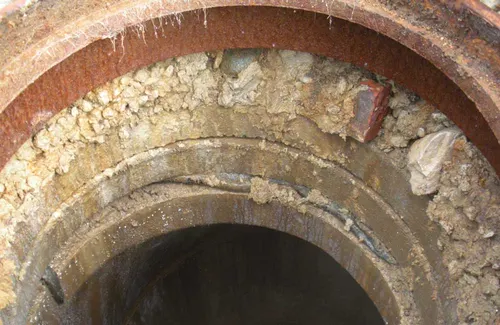
Chimney sections are often the least standardized part of a manhole structure. Traditionally, they are built using stacked concrete grade rings, leveling shims, and patch materials to bring frames to final grade. While this approach allows flexibility during installation, it also introduces multiple interfaces where cracking, movement, and deterioration can occur.
Over time, these materials are exposed to traffic loading, freeze-thaw cycles, corrosion, and settlement. Common failure patterns observed in the field include:
- cracked or shifting grade rings,
- deteriorated or rotting shims,
- separation between patch material and surrounding concrete, and
- uneven load distribution that causes frames to move or rock under traffic.
These issues rarely appear immediately. Instead, they tend to develop gradually, often after rehabilitation work has already been completed below grade. When that happens, utilities are left managing recurring surface-level problems despite significant investment in corrosion protection elsewhere in the structure.
Integrated Chimney Construction as a System-Level Solution
Addressing chimney-related failures requires more than better materials or tighter tolerances at individual connection points. In practice, it means treating the chimney as a structural element that manages load, alignment, and environmental exposure as part of the overall manhole system rather than as a surface detail that gets adjusted over time.
Integrated chimney construction changes outcomes by removing stacked interfaces and isolated bearing points that allow movement to develop under traffic and seasonal stress. By setting the frame at final grade and creating a continuous concrete bearing surface, this approach improves how loads are transferred into the structure and reduces variability at the surface over time. The chimney behaves as a single, predictable component rather than a collection of materials responding independently. This consistency is especially important when paired with composite manhole frames, which are designed to transfer loads vertically and depend on uniform support to perform as intended. When chimney construction and frame design are evaluated together, the conditions that lead to recurring surface-level failures are far less likely to persist across the life of the asset.
How Composite Manhole Frames Improve Long-Term Load Performance
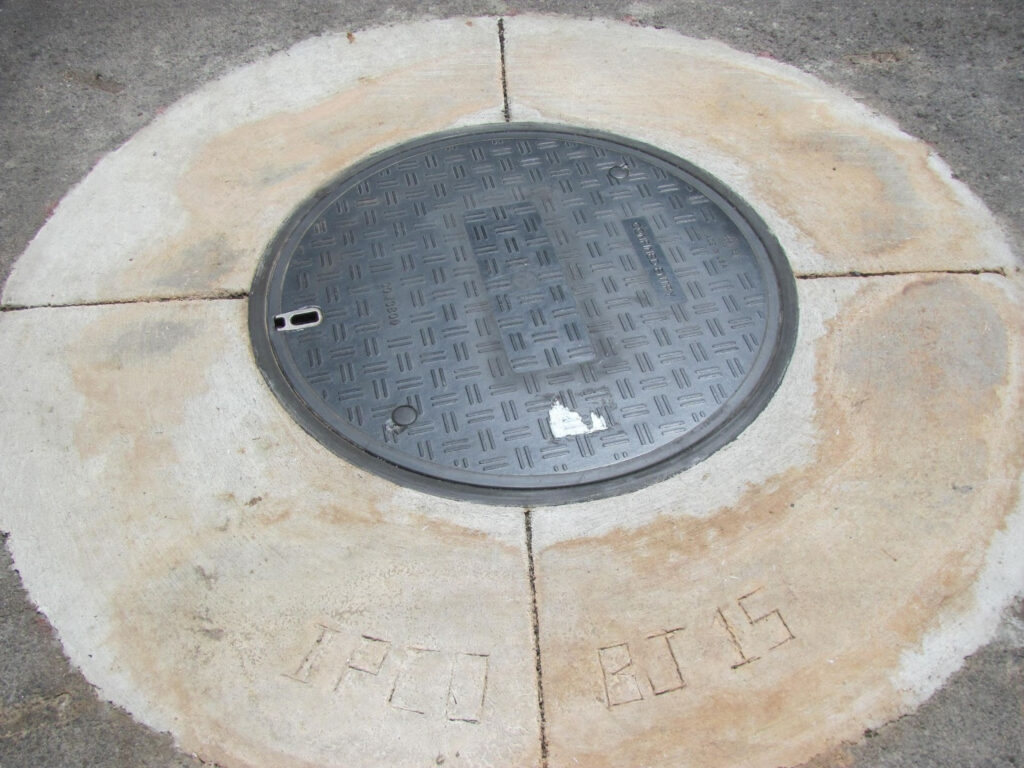
Composite manhole frames are engineered to manage loads differently than traditional cast iron designs. Rather than relying on thin horizontal flanges that can corrode, deform, or concentrate stress at the surface, composite systems transfer forces vertically into the structure through reinforced bearing walls. This design shifts how loads move through the access structure and how they are absorbed over time.
From a system perspective, this approach offers several performance advantages:
- more efficient load transfer into surrounding concrete,
- reduced stress concentrations at the frame interface, and
- improved resistance to corrosion-related degradation.
These benefits, however, depend on proper support conditions at the chimney. Composite frames perform best when their bearing walls are fully supported by solid, continuous concrete rather than fragmented or deteriorated materials. When chimney construction and frame design are aligned, load distribution becomes more predictable under traffic and environmental exposure, supporting long-term performance at grade.
Rehabilitation Projects and the Cost of Leaving the Top Untouched
Manhole rehabilitation has become a major focus for municipalities seeking to extend the service life of aging infrastructure. Cementitious linings, spray-applied coatings, and multi-layer corrosion protection systems can add decades of durability to barrels and cones. However, these investments are often undermined when legacy frames and chimney sections are reinstalled at the surface, reintroducing corrosion, movement, and access challenges at the very point where structural loads and environmental exposure are greatest.
From a system perspective, rehabilitation projects represent a critical opportunity to address access structures comprehensively rather than in isolation. When below-grade rehabilitation is paired with composite frames and integrated chimney construction, surface-level failure modes that typically reappear over time are addressed at the same moment the structure is being renewed. While these upgrades usually account for a small portion of overall rehabilitation budgets, they play an outsized role in determining whether a rehabilitated manhole delivers the full service life municipalities are planning for, or continues to require recurring surface repairs and operational attention.
Designing Access Structures for Long-Term System Performance
When composite frames, integrated chimney construction, and corrosion-resistant materials are evaluated together, access structures shift from recurring problem areas to stable system components. Safety improves, maintenance becomes more predictable, and long-term asset performance is easier to manage because surface-level decisions are aligned with how the rest of the system is expected to perform over time.At Titus Wastewater Solutions, these evaluations are informed by how manholes are actually built, accessed, and maintained in the field. Working directly with the composite manhole specialists at Titus Wastewater Solutions allows municipalities to evaluate access structure decisions in context and make informed choices that support long-term system performance and reliability.
Reaching out today and see how our composite covers can help municipalities make more defensible decisions that support long-term performance and system reliability.