
TL;DR
Lagoon aerator maintenance fails in the field more often than it fails on paper. When service requires a crew to leave the bank, the work gets deferred, and deferred service shows up as falling dissolved oxygen, odor complaints, and permit exposure. Maintenance accessibility is an equipment-selection decision, not an operations problem, and the systems that get serviced on schedule are the ones a crew can reach from shore.
Every piece of lagoon aeration equipment comes with a maintenance plan. Motors get serviced. Bearings get grease. Gearbox oil gets changed, shafts and propellers get inspected, rags get pulled, and submerged diffusers eventually have to be retrieved, cleaned, or replaced.
The procedures may be clearly documented. The service intervals may be listed in the equipment manual. The utility may have the right tools and trained personnel. There is still another question that has to be answered: are your employees willing to perform the work the equipment requires?
A lagoon aerator maintenance plan is only practical when workers can carry it out safely. If routine service means crossing a wastewater lagoon in a boat, climbing onto unstable floating equipment, working near high-voltage power over water, or handling components coated in sludge, the utility eventually discovers that the plan works better on paper than it does in the field.
That is not a minor staffing problem. It is an equipment-selection, engineering, and operational-resilience problem.
Lagoon Aerator Maintenance Access Is Part of the Equipment Decision
Maintenance accessibility is usually treated as something to work out after the aeration system has been selected. The equipment gets sized, the horsepower gets calculated, the units get placed in the lagoon, and the electrical and structural requirements get built into the design. Only later does someone ask how the crew is actually going to work on it. By then, the access limitations are already part of the system.
Lewis Titus, founder of Titus Wastewater Solutions, spent much of his career as a millwright and industrial maintenance professional before he designed lagoon aeration equipment. That background changes what a person notices about a machine. He does not look only at what equipment does when it is running. He also asks:
- What will it take to maintain?
- How will workers reach it?
- What happens when it fails?
- Can it be brought to shore?
- Can it be cleaned before someone works on it?
- What risks are workers expected to accept?
- What happens when the crew refuses?
Those questions belong in the selection process, not in the response to the first breakdown. Equipment that is difficult to maintain rarely reveals it during procurement. It reveals it the first time something fails.
When Routine Lagoon Aerator Maintenance Becomes an Offshore Operation
A maintenance task that is straightforward on land becomes a different job when the equipment sits in a wastewater body. The work order reads the same either way. The conditions do not.
Greasing a motor or bearing, changing gearbox oil, pulling rags off a propeller, inspecting a shaft, troubleshooting an electrical fault, replacing a motor, retrieving a submerged diffuser, connecting lifting equipment, pressure washing fouled components. On shore, these are ordinary maintenance. A worker stands on stable ground with normal access to tools, lifting equipment, and replacement parts, does the job, and moves on to the next work order.
Move that identical task offshore and the list of what it takes to perform it grows in every direction:
- a boat or barge
- multiple workers
- personal flotation devices
- fall protection
- wastewater-resistant personal protective equipment
- rigging and lifting equipment
- additional supervision
- a rescue plan
- favorable weather
- a safe way to transport tools and parts
The maintenance requirement has not changed. The environment has. That is what turns routine preventive maintenance into a high-risk field operation, and it is why a service interval that looks reasonable in a manual can go unmet for months in practice.
Boat Access Is Not a Small Detail
Boat access sounds manageable when it appears as one line in a maintenance procedure. In practice it raises a run of questions that the procedure rarely answers. What type of boat, and is it stable enough for the work? How do workers board the aerator or the maintenance platform? How do tools get transferred? What happens if someone slips, and can a worker be recovered quickly after falling in? What happens in cold weather, high winds, or icy conditions?
The water is not recreational water. It is wastewater. A fall exposes a worker to pathogens, sharp debris, entanglement hazards, and dangerous temperatures. CDC and NIOSH list drowning, falls, and confined spaces among the ways workers are killed during maintenance of sewage and wastewater plants, alongside the bacteria, viruses, and parasites the water itself carries. Even without a fall, crews handle sludge, rags, and contaminated equipment with their hands.
Lewis calls boat-access maintenance one of the most dangerous requirements attached to lagoon aeration. He has also heard superintendents put it more plainly than any specification would:
“My guys won’t go out there.”
A maintenance strategy that depends on personnel entering an environment they are unwilling to enter is not a strategy. It is an assumption, and it holds only until the day someone tests it.
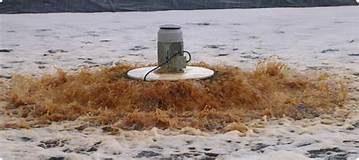
A Floating Aerator Is Not Automatically a Safe Work Platform
A surface aerator can look substantial from the bank. That appearance does not mean it will hold a person steady.
Weight distribution changes the moment a worker climbs onto the unit. Ice adds uneven loading. Tools, a replacement component, and the movement of the work itself all shift the center of gravity, and a float sized to carry a motor was not necessarily sized to carry a motor plus a man plus a toolbag.
Lewis described an incident involving a relatively small high-speed surface aerator that rolled over while someone was attempting to grease it. The worker was performing routine maintenance, exactly as scheduled. The equipment itself created the hazard.
That is worth sitting with, because it reframes the question. The hazard was not the lagoon, the weather, or a shortcut someone took. It was the design of the thing being maintained. Which means the useful questions are design questions: whether the float is large enough to stay stable during service, whether it was ever intended to support workers, where a person is supposed to stand, whether routine service can be completed without climbing onto the unit at all, how ice changes the equation, and what happens if one float takes damage. Most of those have an answer in the submittal. Some of them only have an answer in the field.
A maintenance plan should not assume that a floating machine is a safe maintenance platform. That has to be established, not inferred.
When a Major Component Fails Far From Shore
Maintenance access matters most at the worst possible moment, which is when something large breaks a long way from the bank.
Lewis described large, low-speed surface aerators installed on offshore platforms in very big lagoons. Some carry 100-horsepower motors, along with heavy gearboxes, shafts, and propellers. When one of those components fails, nobody is carrying the replacement out to the unit.
The Replacement Part Cannot Be Carried to the Equipment
Everything about the repair scales up with the size of the component. Crews may be working from boats, from barges, or from the aerator platform itself while disconnecting, rigging, and replacing a piece of machinery that weighs more than the platform they are standing on. The work is not just hazardous. It is slow, weather-dependent, and difficult to stage.
Lewis puts these repairs at hundreds of thousands of dollars and weeks of downtime.
Crane Reach Costs Capacity
The equipment usually has to come out by crane, and this is where distance from shore turns into money. Crane capacity drops as reach increases. The farther the component sits from a place the crane can actually set up, the larger and more expensive the machine has to be to lift the same load, assuming a crane can reach it at all.
That relationship is fixed before the first breakdown. It gets decided the day someone chooses where the units go.
What the Maintenance Plan Has to Answer
Because of that, a maintenance plan for offshore equipment has to cover more than routine service. It has to explain:
- how major components will be reached
- how they will be lifted
- where workers will stand
- how the work area will be stabilized
- how tools and parts will be transported
- how long the unit may be out of service
- how treatment will continue during the repair
That last one is not a footnote. A lagoon running weeks with a unit down is a lagoon running short on mixing energy, and aeration that cannot reach the whole lagoon leaves most of the treatment work undone whether the shortfall comes from a failed motor or an undersized system.
If those answers do not exist before installation, the utility ends up inventing them during a failure, which is the worst available time to discover that equipment is difficult to reach.
Electricity and Wastewater Are a Dangerous Combination
Some floating mechanical aerators require high-voltage electrical power in or over the lagoon. That adds a hazard layer on top of everything else the crew is already managing.
Electrical equipment in a wastewater environment gets worked on by the environment. Corrosion, damaged cords, failed seals, moisture intrusion, worn insulation, loose connections, mechanical stress, ice, and the constant movement of floating equipment all act on it, and they act on it continuously rather than during a maintenance window. Maintenance personnel may also be working on one unit while other energized equipment keeps running nearby.
Disconnects, lockout/tagout, and electrical protection all help. None of them changes the fact that putting electrical components in the water makes the system harder to maintain safely, and the questions worth asking are the ones that come before those controls:
- How is the equipment isolated?
- Where are the disconnects located?
- Can power be verified as off from shore?
- What happens if another unit develops a fault?
- Are workers expected to troubleshoot electrical equipment from a boat?
- Can the motors and controls be located on land instead?
That last question is the one that changes the answer to all the others. Eliminating a hazard is more reliable than managing it, and a system that keeps its electrical components on the bank does not need a procedure for troubleshooting them over water.
Submerged Equipment Creates a Different Exposure Problem
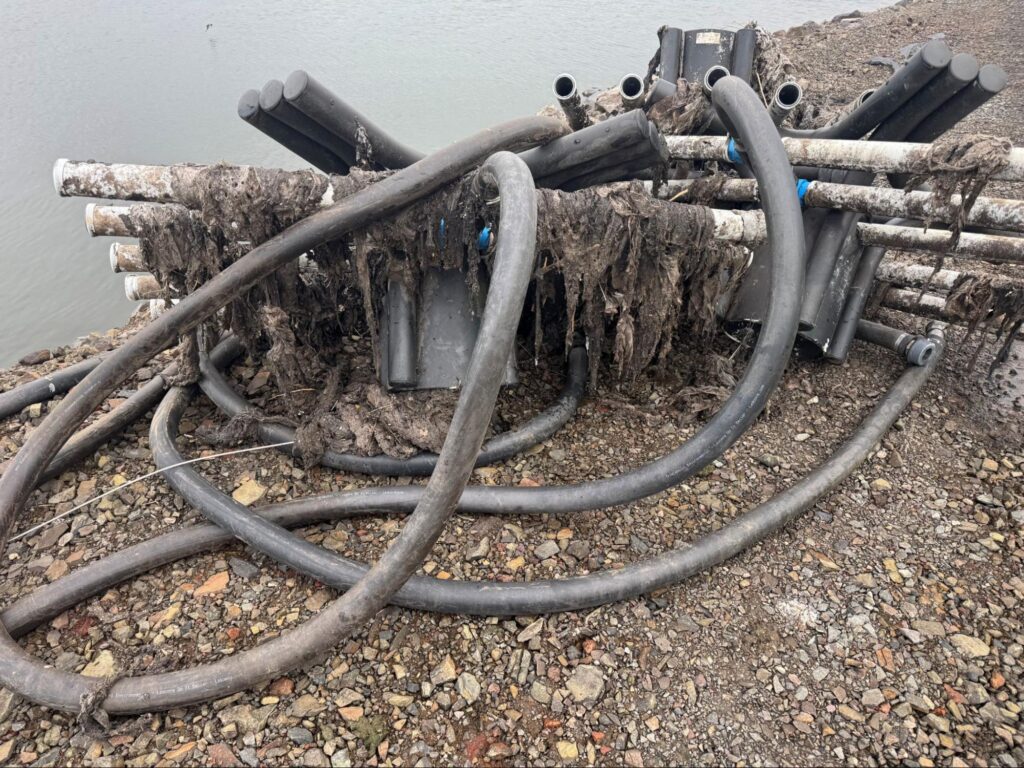
Bottom-diffused systems avoid putting electrical motors on the lagoon surface. They trade that for a retrieval problem.
Diffusers foul. Sludge, biological growth, and rags accumulate on them, and eventually the units have to come out of the lagoon to be cleaned or replaced. Lewis described submerged diffusers that had become buried in roughly 48” inches of sludge after several years in service.
Getting equipment out of that condition is not clean work. Crews take a boat or barge into the lagoon, locate submerged equipment they cannot see, connect a winch or lifting line, pull the units up through accumulated sludge, handle components coated in wastewater solids, pressure wash them, replace membranes, and put everything back. Rags and sludge are hard to control during lifting and cleaning, and a cut or an abrasion on a worker’s hand turns contact into exposure.
So the maintenance question is not whether a diffuser can be cleaned. It is what a specific person has to do to clean it, and under what conditions.
Workers Are Less Willing to Normalize Preventable Risk
It is tempting to read resistance to unpleasant maintenance as a work ethic problem. That reading misses what is actually happening.
Employees are increasingly unwilling to accept risks that can be designed out of the job. They are more aware of exposure hazards, more likely to question an unsafe practice, and less willing to get in a boat on a wastewater lagoon, climb onto unstable machinery, or handle contaminated equipment without real controls in place.
Lewis came up in heavy industry, where workers routinely accepted risks that would draw far more scrutiny today. He is direct about the fact that accepting them was not necessarily the right thing to do.
“They’re not going to do something that they think is going to make them sick or get them hurt. And they shouldn’t.”
That last sentence is the part decision-makers need to sit with. A crew’s refusal is not always a rejection of the job. Often it is a warning that the equipment, the access method, or the maintenance procedure is asking for more risk than the task is worth.
What Happens When the Crew Says No
Put it in concrete terms. A mechanical aerator is wrapped with rags. The motor overloaded, the breaker tripped, and the unit is no longer contributing oxygen or mixing to the lagoon.
The operating team knows exactly what the job is. Someone has to reach the unit, clear the material, and put it back in service. It is not a complicated repair. It is a repair that requires getting out there.
The crew declines.
At that point the utility is working through a different set of options than the work order describes:
- find a specialty contractor
- rent a boat or barge
- rent lifting or retrieval equipment
- develop a new safety procedure
- wait for workable weather
- delay the repair
- operate with reduced aeration
- move other equipment to compensate
- pay emergency labor rates
- replace or redesign the system
None of those is a maintenance task. The equipment failure stopped being a mechanical problem and became a staffing, safety, procurement, and treatment-capacity problem, all at once, on a timeline nobody chose.
The bigger issue is what happens when it repeats. A utility that cannot service its own aeration equipment ends up dependent on outside contractors for work it assumed would be handled in-house. That dependency does not show up on the purchase order, and it is one of the largest gaps between what a system costs to buy and what it costs to own.
What Delayed Lagoon Aerator Maintenance Actually Costs
Maintenance that is difficult, unpleasant, or dangerous gets postponed. A crew delays unragging an aerator until conditions improve. A utility keeps running a failing motor while it waits on a crane quote. Fouled diffusers stay in the lagoon because retrieving them is a project rather than a task. The equipment keeps running the whole time, which is what makes deferral feel survivable.
Deferred Service Shows Up in the Effluent
It is survivable right up until it is not. Reduced mixing means solids settle where oxygen cannot reach them, dissolved oxygen falls, and the sludge blanket thickens.
A thicker blanket takes more energy to move and puts more stress on equipment already past due for service, so the next failure is worse than the one that got deferred. Odor follows the anaerobic conditions, and effluent numbers follow the odor.
That is where a maintenance decision turns into a compliance problem. EPA reports that approximately 60 percent of facilities in recent significant noncompliance with their Clean Water Act discharge permits are wastewater treatment plants, and its guidance for small lagoons points at operational and maintenance issues as the drivers.
Unsafe Maintenance Has a Price Tag Either Way
The costs land whether or not anyone gets hurt. Extra staffing, safety training, protective and rescue equipment, contractor support, crane and boat rentals, higher insurance, and lost productivity are all real budget lines a utility pays to manage a hazard it chose when it bought the equipment.
An injury adds costs that never make a spreadsheet, including whether anyone else on the crew is willing to do that job afterward.
That is why safety belongs inside the lifecycle-cost conversation. An aerator with a lower purchase price is not the cheaper choice if it commits the utility to years of hazardous, contractor-dependent maintenance.
Make Maintenance Access an Engineering Criterion
Aeration systems get designed around treatment requirements. Flow, loading, oxygen demand, horsepower. Maintenance access deserves the same weight in the same conversation, because it is just as much a design decision and far harder to change later.
Manufacturer instructions are the starting point, not the answer. “Serviceable by boat” does not say whether the utility owns a suitable boat, whether anyone on staff is trained to run it, or whether a rescue procedure exists if someone goes in. “Can be pulled for maintenance” does not say what the unit weighs, whether it can be pulled through accumulated sludge, or where it gets set down once it is on shore. The instructions describe the task. A real maintenance plan describes how that task gets done safely at one specific site.
The people best positioned to spot the gap are usually the last ones consulted. Equipment decisions run through engineers, consultants, administrators, and purchasing, while the maintenance staff who will live with the system often do not see it until the design is nearly final. A maintenance employee can look at a proposed aerator location and know immediately that it cannot be serviced with the equipment the utility already owns. That insight is worth far more before construction than after installation.
A Pre-Purchase Lagoon Aerator Maintenance Checklist
Before specifying lagoon aeration equipment, get these answered in writing. Every one of them is cheaper to answer now than during a failure.
Access
- Can all routine service be performed from shore, and if not, exactly what requires boat access?
- Can the equipment be pulled to the bank?
- How will the unit be lifted, where are the lifting points, and what size crane is required?
Worker exposure
- Will workers handle untreated wastewater, sludge, or rags?
- Can components be cleaned and disinfected before anyone repairs them?
- Is the equipment designed to support a worker standing on it, and how do ice and uneven loading affect that?
Electrical
- Is power located in the lagoon?
- Can all energy sources be isolated and verified from shore?
Staffing and failure planning
- How many people are required for routine service, and does the utility have them?
- Are employees willing to perform the work as the manufacturer describes it?
- What happens if the equipment fails during peak loading, and how long will retrieval and repair take?
- What happens if weather prevents access, and is backup aeration available?
Document the answers before the purchase order goes out. A vendor who cannot answer them is telling you something.
Design So the Work Happens on the Bank
Every mechanical system needs maintenance. The goal is not to pretend otherwise. It is to cut down how often a worker has to enter a hazardous environment to perform it.
That means specifying equipment that can be:
- serviced from shore
- pulled to the bank
- lifted with a small crane
- cleaned and disinfected before anyone handles it
- isolated without entering the lagoon
Moving the work from the water to the bank changes the entire risk profile. Workers get stable footing. Tools and lifting equipment become usable. Contaminated components get washed before someone puts hands on them. Rescue from a lagoon stops being part of a routine service plan. The work does not disappear, but it becomes work a crew will actually do on schedule.
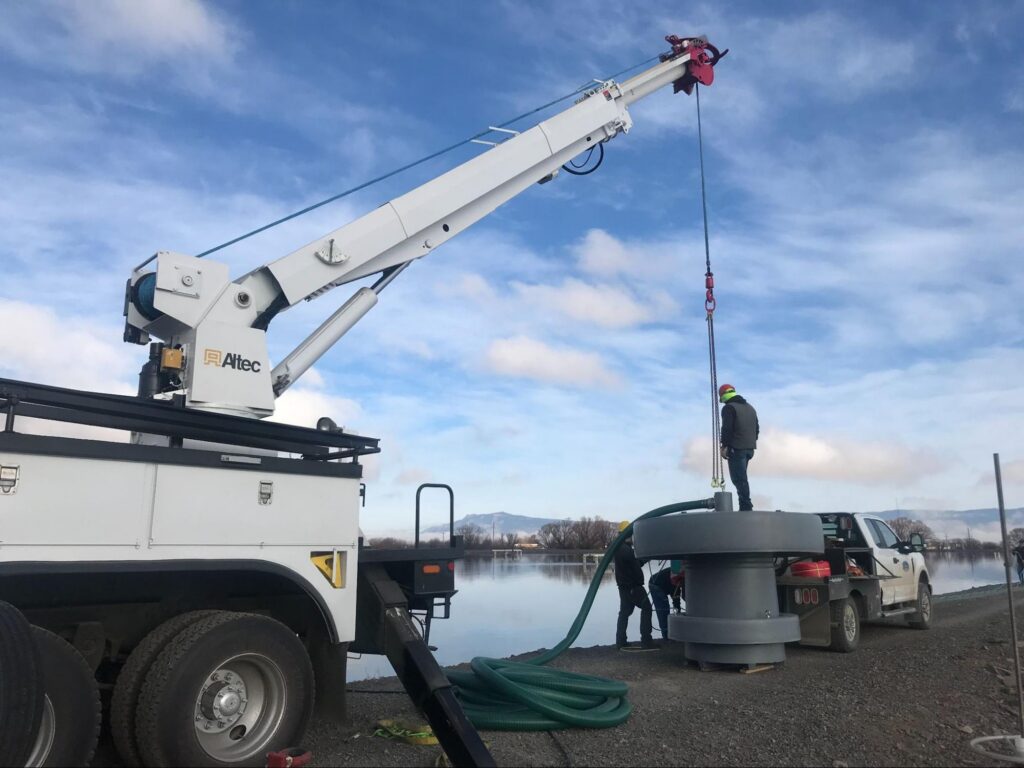
This is also where a utility has to be honest about the crew it has rather than the crew a submittal assumes. Available staffing, existing lifting equipment, seasonal weather, contractor availability, and willingness to perform lagoon-entry work are all real constraints. If the utility does not have people prepared to maintain offshore equipment, that is a design constraint, not a training problem. Buying the equipment anyway does not make it disappear. It postpones it until the day the system needs service.
Titus Wastewater Solutions builds around that principle. The Twister-FL Floating Aerator is air-driven with no moving parts in the water, which removes the submerged motors, gearboxes, and propellers that drive most of the maintenance described in this article.
Lagoon Aerator Maintenance FAQs
Can lagoon aerators be maintained without a boat?
Some can. It depends entirely on the equipment. Systems designed to be serviced from shore or pulled to the bank eliminate boat access for routine work, while floating mechanical aerators and bottom-diffused systems generally require crews to go out on the lagoon. This is a specification question, so it needs answering before purchase rather than after.
What are the main safety hazards of servicing lagoon aeration equipment?
The recurring ones are falls into wastewater, unstable footing on floating equipment, electrical hazards where power is located over or in the lagoon, and contact with sludge, rags, and pathogens. CDC and NIOSH also list drowning and confined spaces among the causes of worker deaths during wastewater plant maintenance.
Why do maintenance crews refuse to service offshore aerators?
Usually because the risk is real and avoidable. Crossing a wastewater lagoon by boat, climbing onto equipment not designed to hold a person, and handling contaminated components are hazards that can be designed out of the job. A refusal is often a signal that the access method asks for more risk than the task warrants.
What happens if lagoon aerator maintenance gets delayed?
Mixing drops first, then dissolved oxygen, and the sludge blanket thickens. That raises energy use, stresses equipment further, and eventually shows up as odor complaints and effluent numbers moving toward permit limits. Deferred service is survivable for a while, which is exactly why it tends to continue until something fails outright.
Should maintenance staff be involved in aeration equipment selection?
Yes, and earlier than most utilities involve them. Operators and maintenance personnel can identify access problems that are not visible in a submittal, including whether a proposed location can be serviced with the lifting equipment the utility already owns. That insight costs nothing before construction and a great deal after.
Before the Equipment Goes In the Water
A maintenance plan is not a binder on a shelf. It is a realistic description of how trained people will keep equipment running under the conditions that actually exist at one site: the weight of the components, the distance from shore, the stability of the work surface, the exposure, the electrical hazards, the staff on hand, and what happens when something fails at the worst time.
Most of all, it accounts for the people expected to do the work. So before choosing a lagoon aeration system, ask the operators and the maintenance crew directly: would you be willing and equipped to maintain this system the way the manufacturer says it must be maintained?
If the answer is no, the utility does not have a maintenance plan. It has an equipment problem waiting to happen. If you are weighing an aeration system and want a straight answer about what it will take to service it, talk to the Titus WWS team before the equipment goes in the water, not after.