
For decades, cast iron has been the default material for manholes, largely because it was familiar and widely accepted. But in practice, that familiarity has come with tradeoffs that many municipalities continue to absorb every day, from worker injuries and access delays to corrosion-related failures and persistent noise complaints.
According to Lewis Titus of Titus Wastewater Solutions, the biggest challenges with traditional manhole systems often appear before crews even begin their work. Opening and closing heavy, corroded lids is one of the most common sources of injuries in the utility sector, and seized or difficult-to-access structures can slow inspections, maintenance, and emergency response. These issues are not isolated to the cover itself. They affect how entire collection systems are operated and maintained.
Composite manholes are gaining attention not as a trend, but as a practical response to these operational realities. Their value lies in how material choice influences safety, access, durability, and long-term performance when viewed as part of a complete system. For municipalities balancing reliability, lifecycle planning, and workforce safety, this shift reflects a broader rethinking of how infrastructure decisions are made.
This article looks at why composite manholes are becoming part of that conversation, drawing on real-world field experience to examine how system-level outcomes are shaped long before crews ever go below grade.
Safety: Addressing a Leading Source of Utility Injuries
Across the utility sector, opening and closing manhole structures remains one of the most common sources of workplace injuries. Industry safety research, including findings published by Liberty Mutual, has consistently shown that for utility crews, manually opening access covers is a leading contributor to lost-time incidents. In collection systems, this risk often appears before crews ever enter a confined space, during routine access to structures that are opened and closed repeatedly throughout their service life.
Traditional cast iron systems contribute directly to this problem through a combination of weight and corrosion. Covers commonly exceed 120 pounds and frequently corrosion weld to frames over time, forcing operators to strike them with a sledge hammer to break the bond. It also requires awkward lifting positions and repeatedly prying to gain access. Broken toes and fingers, torn biceps and other related injuries are common. These access challenges are part of everyday maintenance and inspection work, which makes them difficult to address through training or procedural controls alone.
Composite manholes change the safety equation by redesigning how access occurs at grade. Instead of relying on brute force to overcome seized or oversized components, system design shifts the physical demand away from the operator through:
- significantly reduced component weight,
- upright lifting mechanisms that limit bending and twisting, and
- corrosion-resistant interfaces that prevent covers from seizing to frames.
By removing excessive force and improvised workarounds from routine access, these design changes help reduce injuries, limit lost time, and create a safer starting point for every task that follows.

Corrosion, Access, and Maintenance Reality
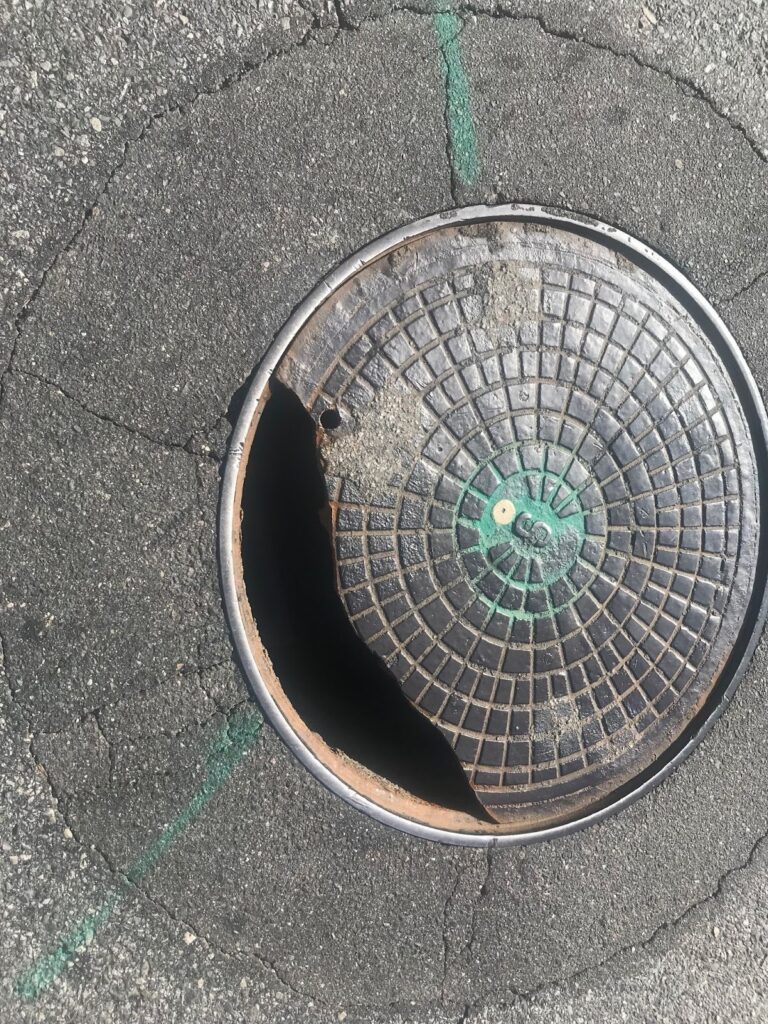
Corrosion is one of the most persistent challenges facing collection systems, particularly in coastal regions and environments with elevated hydrogen sulfide levels. Over time, traditional cast iron frames and covers can bond together, creating what field crews often describe as a “corrosion weld.” When that happens, routine access becomes unpredictable, labor-intensive, and sometimes impossible without heavy tools or additional personnel.
In practice, this directly affects system reliability. During one field visit in California, Titus encountered a street with dozens of manholes where only a single structure could be opened due to corrosion. Situations like this delay inspections, complicate emergency response, and force utilities to defer maintenance that would otherwise be routine. When access is compromised, the entire system becomes harder to manage, not because of downstream failures, but because crews cannot reliably reach the infrastructure they are responsible for maintaining.
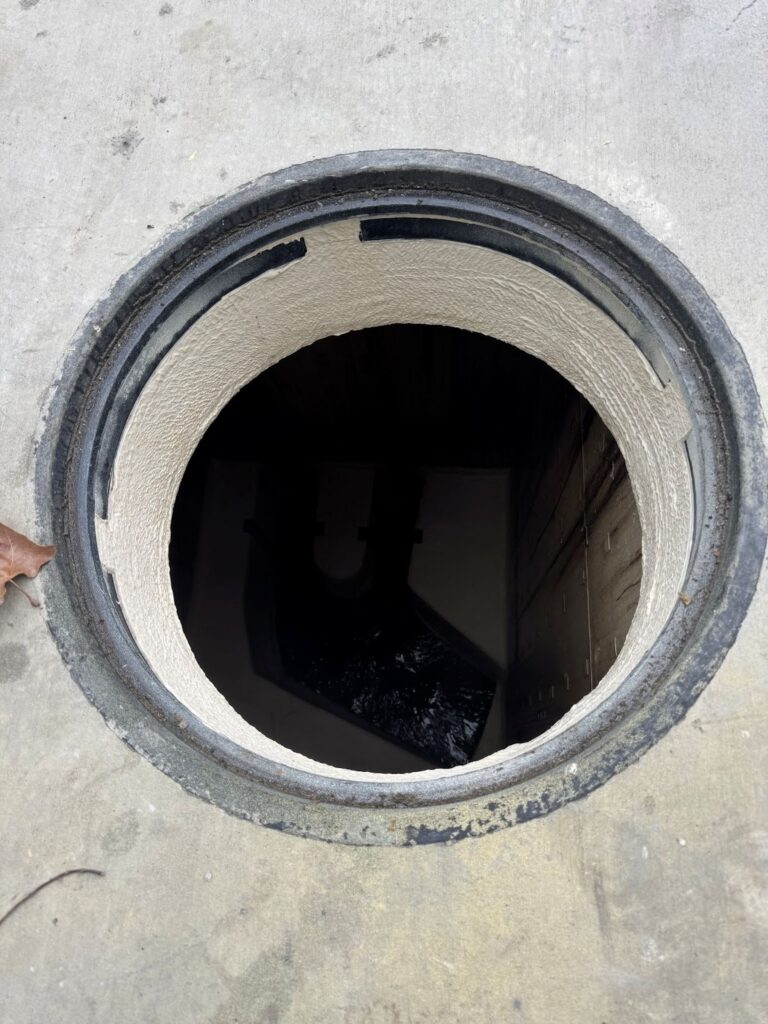
Composite manholes address these challenges by removing corrosion from the access equation altogether. Because composite materials do not rust or bond to frames, lids remain operable over time, even in aggressive environments. Just as importantly, well-designed composite systems create a stable interface between the frame and cover, reducing movement under traffic and minimizing noise. Quiet, consistent access may seem secondary, but it has real operational value, reducing neighborhood complaints and eliminating the need for temporary field fixes that rarely provide lasting results.
Structural Performance Without Added Weight
Structural performance is often where skepticism around composite materials emerges, particularly among engineers responsible for load ratings and long-term reliability. The assumption that lighter materials must sacrifice strength is understandable, especially in applications subjected to constant traffic loading and impact. In practice, however, performance depends far more on design and testing than on material weight alone.
Field and laboratory testing conducted by Lewis Titus challenges that assumption directly. Under controlled load conditions, traditional cast iron covers typically fail at lower thresholds and can fracture suddenly under extreme stress. Composite systems, when properly engineered, distribute load differently and maintain structural integrity well beyond those limits. In hydraulic testing, composite lids have demonstrated roughly double the load capacity of comparable cast iron covers while weighing a fraction as much.
Load rating alone does not tell the full story. Long-term reliability depends on how materials respond to repeated stress over time. In cyclic testing designed to simulate years of heavy truck traffic, composite lids endured millions of load cycles without measurable loss in performance. This combination of strength, fatigue resistance, and reduced weight changes how engineers can think about durability at grade, without introducing additional handling risk for crews.
Managing Unauthorized Access at Grade
Unauthorized access to manholes presents a real public safety and liability concern for municipalities. In systems where cast iron components carry scrap value, access points can become targets for opportunistic theft, leaving structures open or unsecured. These incidents introduce immediate hazards in streets, sidewalks, and rights of way, while also creating downstream operational and legal challenges for utilities responsible for public infrastructure.
From an operational standpoint, managing access at grade is about reducing both risk and unpredictability. When covers are missing, displaced, or tampered with, utilities are often forced into reactive response modes that divert crews from planned maintenance and inspections. Limiting unplanned access helps shift system management from emergency response toward consistency and control.
In practical terms, municipalities are often trying to reduce exposure across a small set of recurring risk scenarios, including:
- unsecured openings that create fall hazards,
- emergency callouts tied to missing or displaced covers, and
- unauthorized access to confined spaces.
Addressing these risks requires attention to both material choice and access control, particularly in environments where public safety and liability exposure intersect at grade.
Reframing the Manhole as a System Component
Manholes are often treated as simple access points, but in practice they function as critical interfaces between infrastructure systems, field crews, and the public. Decisions made at grade influence how safely crews can work, how reliably systems can be maintained, and how communities experience the infrastructure around them. When access is unreliable or inconsistent, the consequences show up quickly in injury risk, delayed maintenance, and reactive response.
Viewing manholes as part of a broader system changes how material and design decisions are evaluated. Safety, corrosion resistance, structural reliability, noise control, and access security are not isolated features. They are interconnected factors that shape long-term performance and lifecycle planning. Addressing one without considering the others often leads to recurring issues that surface over time, not because systems failed downstream, but because access at grade became a constraint.
This is where experience matters. At Titus Wastewater Solutions, system performance is evaluated from the perspective of how infrastructure is actually accessed, maintained, and managed in the field. For municipalities planning upgrades or reassessing material choices, working directly with Titus’ engineering and manufacturing team allows those discussions to move beyond specifications and into real operating conditions. Reaching out to the composite manhole specialists at Titus Wastewater Solutions can help municipalities evaluate where these systems fit within a broader infrastructure strategy and make more defensible, long-term decisions.